Broken Faith
Preface
My faith broke because of the Church. If someone were to ask me how how I feel about the Church, I would probably respond with something like: "I no longer believe the same way I used to, but I love what I believe now." What do I believe? I believe that we are meant to live good. Life is beautiful - but the Church does not always facilitate that beauty. I was raised in the Church of Jesus Christ of Latter-Day saints. I did everything: primary, baptism, young men's, seminary, mission, Temple, and my kids were born into the church. I held callings, I participated, I taught, I served, I even worked for the church. I had questions and doubts, but I practice my faith by doing and putting in the effort - but it wasn't enough. As I interacted with the Church, I noticed things that are wrong, immoral, and troubling. I was deeply bothered by the issues I saw in the Church.
The Church is not the source of truth nor peace that it claims to be. The Church focuses on attendance, callings, worthiness, assignments - it emphasizes the minutia of life and how the minutia of life right now will affect our standing in the afterlife. It is misguided. Christ taught a pure, simple form of faith and how to live. The Church has bundled up faith into a program, a product, and focuses on participation, branding, marketing, and public relations. The Church has deep pockets and an army of lawyers; it is surrounded by scandal and lawsuits - some of which it filed. The Church does not behave like a Church should - it does not do as Christ would - and that bothers me.
One day, it all came crashing down and I realized I couldn't support the Church anymore. Something needed to change - I needed to change. I needed to figure out what about the Church bothered me. And I needed to figure out my beliefs and my faith.
I found the process of researching, thinking, and writing all this to be helpful in my personal faith journey. I was angry because I felt betrayed by the Church. I was angry at the Church, I was angry with religion, I was angry with myself. I distanced myself from my faith. Faith that I was raised in and faith that I modeled my life around. That distance brought a void, and I filled it with anger. Sometimes that anger lashed out - I’m sorry.
For a time, I questioned if God existed. I was uncertain what I believed. I eventually settled on a belief that there is a God, but that we lack the ability to comprehend the scope of God's existence. Religions have tried to define and explain God, and have failed - but many have succeeded in monetizing the concept of God. I continued with a desire to believe in God and Christ, but knowing that I could not accept the Church, or any other Church, as God's institution. I reviewed my faith in Christ, and recognized core values that I hold dear. Christ taught simply, but churches have complicated it. I settled on a concept of "Simple Faith". Simple faith is just faith that there is more - anything beyond "Simple faith" is just guessing and is neither useful nor accurate.
I began to think about Church attendance, Sacrament, The Priesthood, Baptism, Temples, and the Second Coming. I began to recognize that the Church, indeed all churches, are not what Christ intended.
This process and these realizations have helped me to heal. I have a new passion about my relationship with God and Christ - and it is not anchored to the church, tithing, a temple recommend, a calling, etc.
A major problem is that people ‘believe in the Church’ - that is a flawed approach. One should never believe in ‘The Church’, but one can believe in God or Christ, or something more - but don’t ’believe’ in an institution.
Why does this matter to me? I could have chosen to ignore all this, that is what a good Church member would have done. But if the Church demands my attendance, my time, and my money, then I choose to hold the Church to a higher standard - a standard of honesty and integrity, which it has failed. There are better ways for me to show my commitment to my faith than the ways outlined by the Church.
So here I am. I have faith. I don’t "believe in the Church," but I do believe Christ taught correct principles that can make our lives better. I believe in God. I have some anger toward the Church, but I've figured out why - and that resolution has helped. I am happy, and I feel a stronger spiritual relationship with God.
This is my faith journey. My journey as a researched and documented all that I found wrong within the Church. The Church is not the source of truth that it claims to be - it is a creation of men. The answers provided by the Church for these issues are either insufficient or deflections - and that is unacceptable for an organization that claims to be guided by God. This is not just ‘questions’, they are real issues, contradictions, dishonest and immoral actions - they all deserve attention.
After reading everything that is wrong with the Church, please read the appendix. It addresses what I believe now - that our faith and our spirituality should be simple, as Christ intended.
Chapter 1: Introduction
Throughout the history of The Church of Jesus Christ of Latter-Day Saints, certain teachings, policies, and historical actions have raised real questions that deserve careful examination. This document addresses those questions directly, presenting evidence from official Church sources, scriptures, and historical records. The issues covered here aren't matters of opinion - they're documented inconsistencies that deserve serious consideration.
The issues I present in this introduction are important because they are recurring! They are core to many of the following chapters.
The Nature of Prophetic Authority
The Church teaches a clear doctrine regarding prophetic authority: "What I the Lord have spoken, I have spoken, and I excuse not myself; and though the heavens and the earth pass away, my word shall not pass away, but shall all be fulfilled, whether by mine own voice or by the voice of my servants, it is the same" (D&C 1:38). This sets a clear standard within LDS theology: when prophets speak in their official capacity, their words carry divine authority. This principle, foundational to Latter-Day Saint theology, introduces problems when you review prophetic teachings and statements now ignored, corrected, or disavowed by the Church.
Prophetic Opinion
In the April 2022 General Conference, Elder Dale G. Renlund taught "Ever since God appointed prophets, they have been authorized to speak on His behalf. But they do not pronounce doctrines fabricated "of [their] own mind" or teach what has not been revealed." (Your Divine Nature and Eternal Destiny | Dale G. Renlund | April 2022) [31]. I have seen teachings of prophets discarded by other prophets and by members, claiming that the teaching was the opinion of that man. These teachings were taught in his role as a "prophet," but because time has passed, politics have changed, or church leadership has changed, they are now labeled mere "opinion." This practice is not consistent with what Elder Renlund clearly taught.
Doctrine vs Policy
Some people try to resolve these inconsistencies by separating "doctrine" from "policy," suggesting that certain teachings were merely policy and therefore subject to change. However, Dallin H. Oaks addressed this distinction directly in a 1988 interview: "I don't know that it's possible to distinguish between policy and doctrine in a church that believes in continuing revelation and sustains its leader as a prophet" (Interview with Oaks and Maxwell about Mormon Priesthood Ban - Newspapers.com). This makes it clear that in a church claiming continuing revelation, policies and doctrines can't be separated - both come from the same source of authority. To question a policy is to question the revelation behind it. If policies are not grounded in doctrine, they have no real authority. Looking at the pattern of changes to Church teachings shows that these modifications often line up with current social, cultural, and political trends rather than timeless divine truth.
Evolving Morality
When discussing polygamy, the priesthood and race, pioneer–native conflicts, young marriages, Word of Wisdom non‑compliance, and similar issues, people often reply, "It was a different time," as if that excuses those actions. I argue we must evaluate historical people and actions by modern moral standards: many past practices - slavery, polygamy, and priesthood restrictions based on race - were wrong then and are wrong now. Morality is not merely popular opinion or social acceptability; we have a moral obligation to acknowledge past wrongs and learn from them, otherwise we risk repeating them. Justifying that it was "okay back then" is morally delinquent.
The All-or-Nothing Standard
Gordon B. Hinckley established the standard through which the Church should be evaluated: "Each of us has to face the matter - either the Church is true, or it is a fraud. There is no middle ground. It is the church and kingdom of God, or it is nothing" (General Conference April 2003 - Loyalty). This binary proposition leaves no room for middle ground. Do the leaders of the Church teach half-truths? Does the prophet teach their opinion 50% of the time? The Church would tell you no! So faithful members of the Church are expected to accept ALL teachings.
The following chapters examine specific issues that challenge the Church's claim to be led by continuing revelation from God. Each topic is supported by official Church sources, scriptures, and documented historical evidence.
Topics Covered:
- Introduction
- Book of Mormon
- Book of Abraham
- Race
- Baptism of Children of Same-Sex Couples
- Prophets
- Joseph Smith
- Polygamy
- Garments
- Temple
- Tithing
- 2023 SEC Violations and Fine
- Word of Wisdom
- Miscellaneous Topics
- Conclusions
- Appendix - The Simple Teachings of Christ
Chapter 2: The Book of Mormon
The Book of Mormon is presented as a literal historical record translated by divine power. Yet looking at how the Church has modified this sacred text - particularly passages and commentary related to race - raises real questions about scriptural authority and honesty. The pattern of these changes shows a consistent effort to hide rather than address problematic teachings.
Changes to the Introduction Page
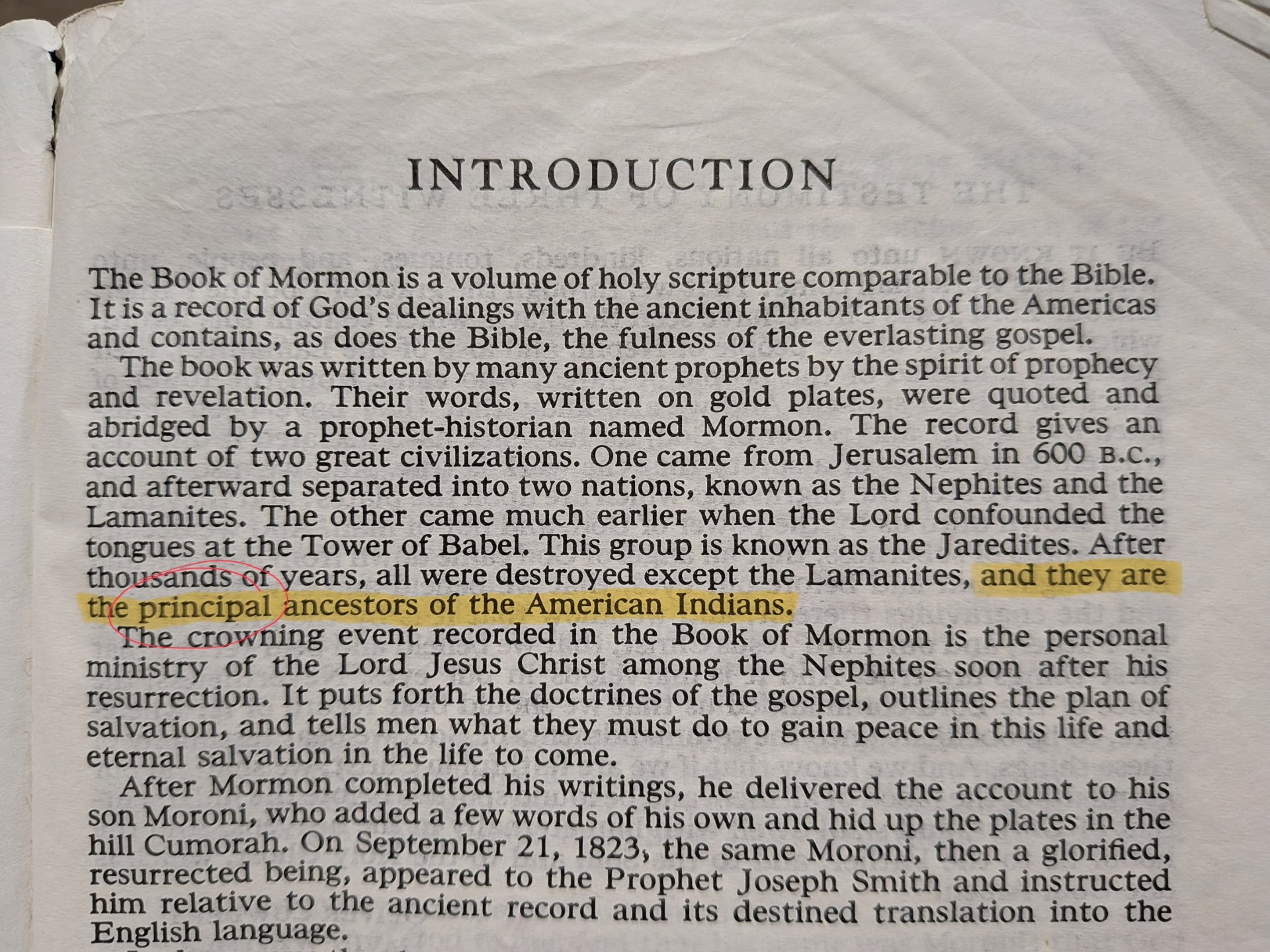
Previous: "After thousands of years, all were destroyed except the Lamanites, and they are the principal ancestors of the American Indians." Current: "After thousands of years, all were destroyed except the Lamanites, and they are among the ancestors of the American Indians."
| Before | After |
|---|---|
 |
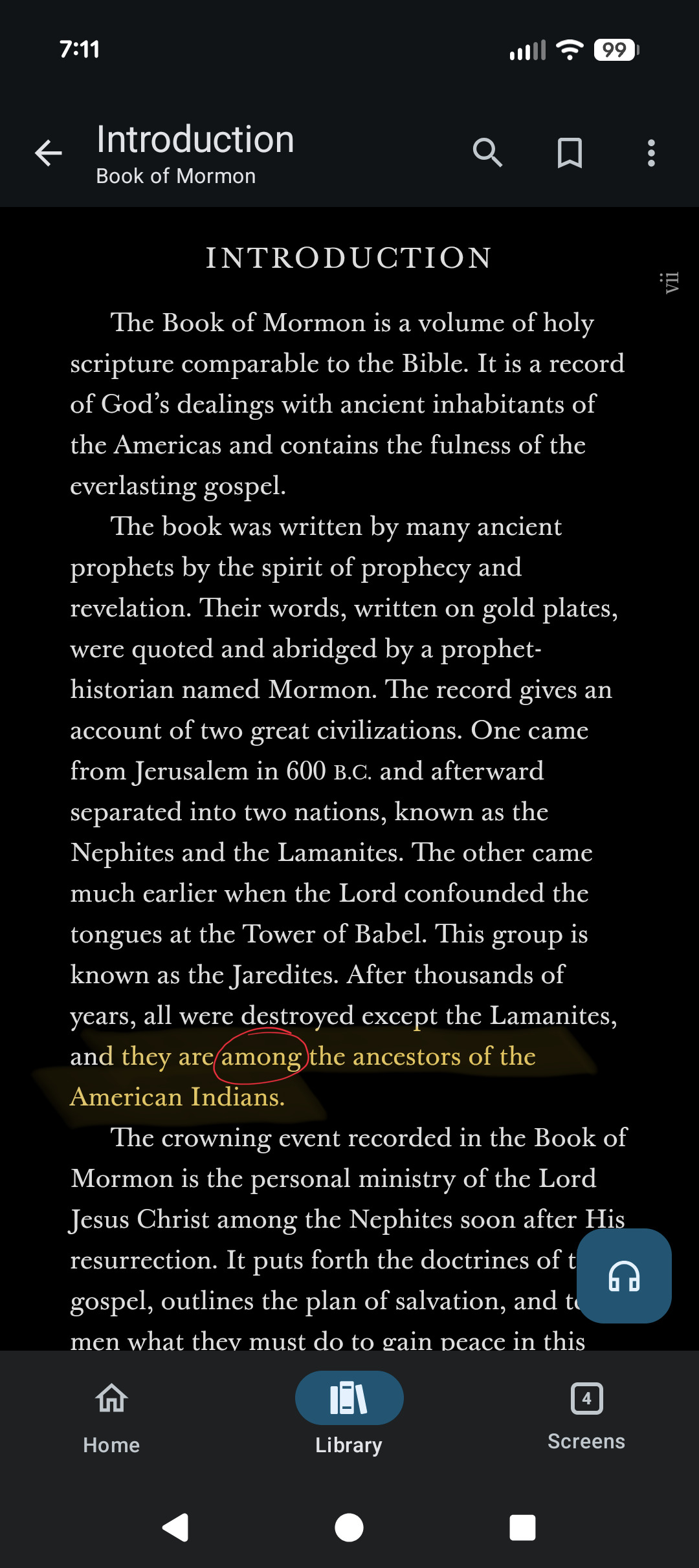 |
The change in the Book of Mormon's introduction reflects a desire for greater caution in light of scientific findings, as explained in the Gospel Topics Essay - Book of Mormon and DNA Studies. The Church released this article and addresses the DNA research showing that Native Americans have Asian, not Hebrew, ancestry. The essay tries to reconcile the scientific evidence with scriptural claims by suggesting that Hebrew DNA markers were diluted and lost over time. This explanation doesn't hold up scientifically. Genetic markers from a population migrating to the Americas in 600 B.C. would still be detectable after only 1,500 years. Modern commercial DNA tests routinely trace ancestral origins much further back than this. If Lamanite DNA markers are completely absent, then by definition, they are not the ancestors of Native Americans. The change from "principal ancestors" to "among the ancestors" is a retreat from the Book of Mormon's strong historical claims when faced with hard evidence.
Changes to Chapter Descriptions
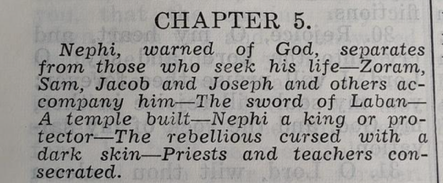
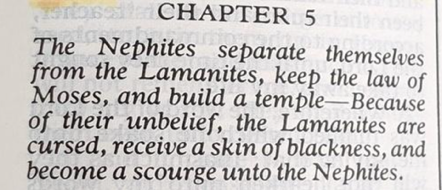
2 Nephi 5 Chapter Description - Changed 3 times:
- 1955 Edition: Nephi, warned of God, separates from those who seek his life – Zoram, Sam, Jacob, and Joseph and others accompany him – The sword of Laban – A temple built – Nephi is a king or protector – The rebellious cursed with a dark skin – Priests and teachers consecrated.
- 1981 Edition: The Nephites separate themselves from the Lamanites, keep the law of Moses, and build a temple – Because of their unbelief, the Lamanites are cursed, receive a skin of blackness, and become a scourge unto the Nephites.
- Current Edition: The Nephites separate themselves from the Lamanites, keep the law of Moses, and build a temple – Because of their unbelief, the Lamanites are cut off from the presence of the Lord, are cursed, and become a scourge unto the Nephites. About 588-559 B.C.
| 1955 | 1981 | Current |
|---|---|---|
 |
 |
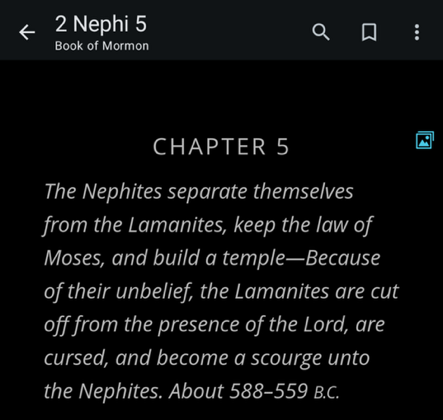 |
The historical changing of these chapter descriptions shows a clear pattern of covering things up. Each version removes more explicit references to skin color, until the current edition drops racial language entirely. This raises a straightforward question: If these descriptions accurately summarized the text in 1955 and 1981, what justifies changing them? The scripture itself hasn't changed - only the summary has. This doesn't address the racial topic, it tries to hide it. Rather than honestly confronting the topic, the Church has quietly revised its summaries, hoping future members won't know what the text originally emphasized.
Changes to Scripture Wording
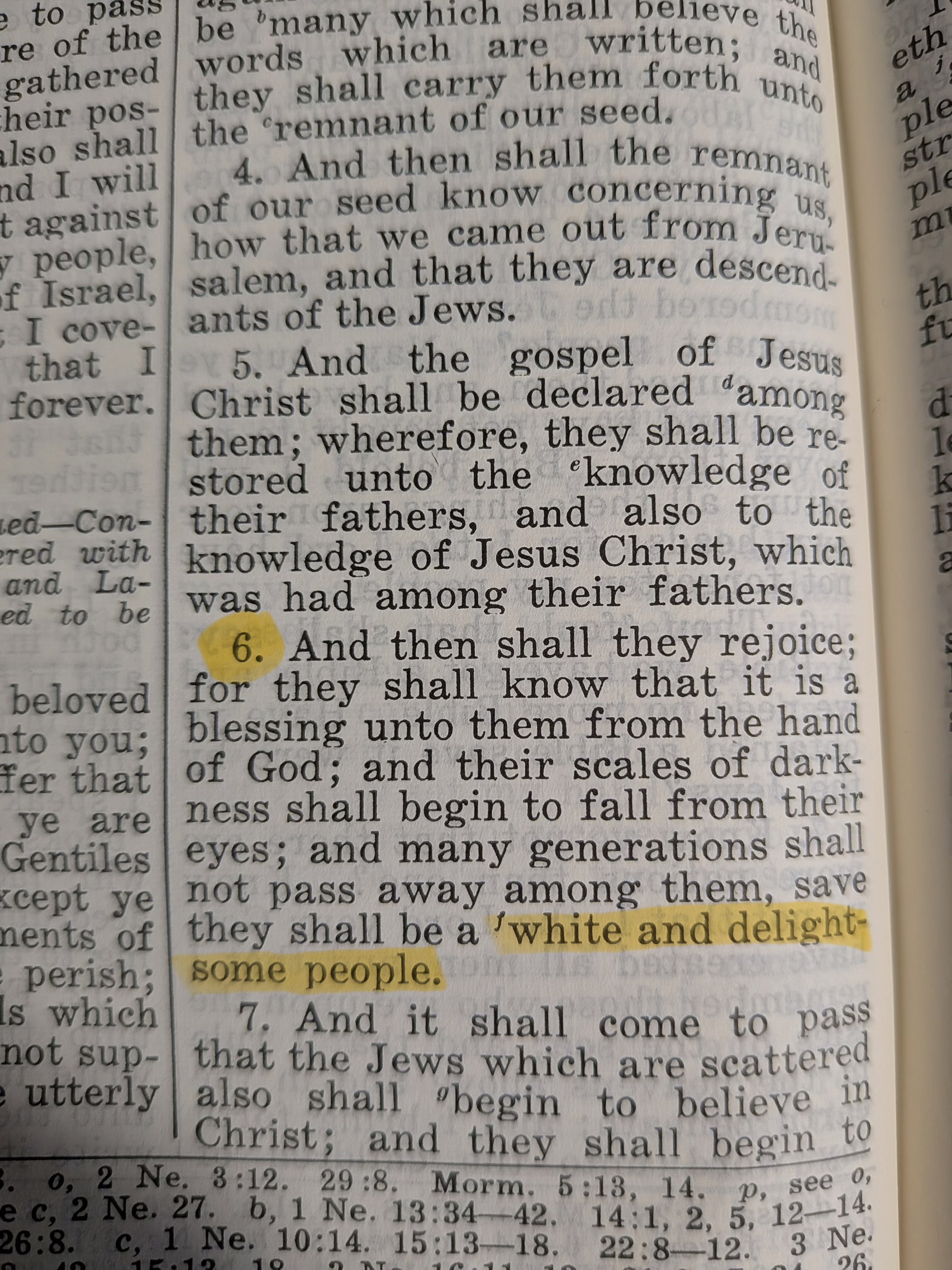
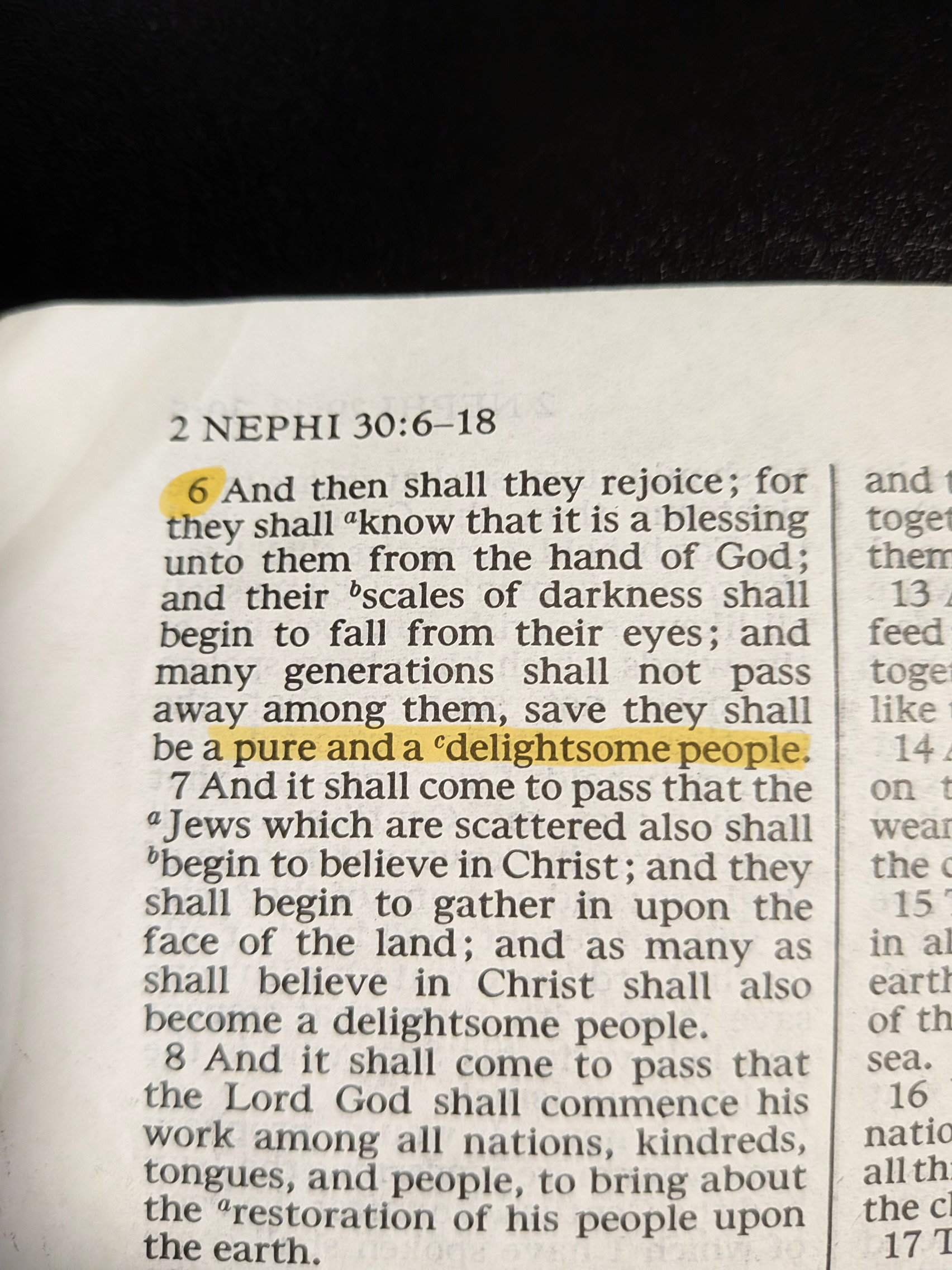
2 Nephi 30:6 was changed. Earlier editions called the Nephite people "a white and a delightsome people"; the current edition reads "a pure and a delightsome people." This change is deeply problematic. The Church's approach wasn't to explain the racial meaning of "white" - it was to edit the scripture itself. In Latter-Day Saint tradition, individual words in scripture carry profound significance. The Church quietly swapped one word for another is dishonest and it disregards the original translation and process.
| Before | After |
|---|---|
 |
 |
Changes to Come Follow Me Manual - Book of Mormon 2020
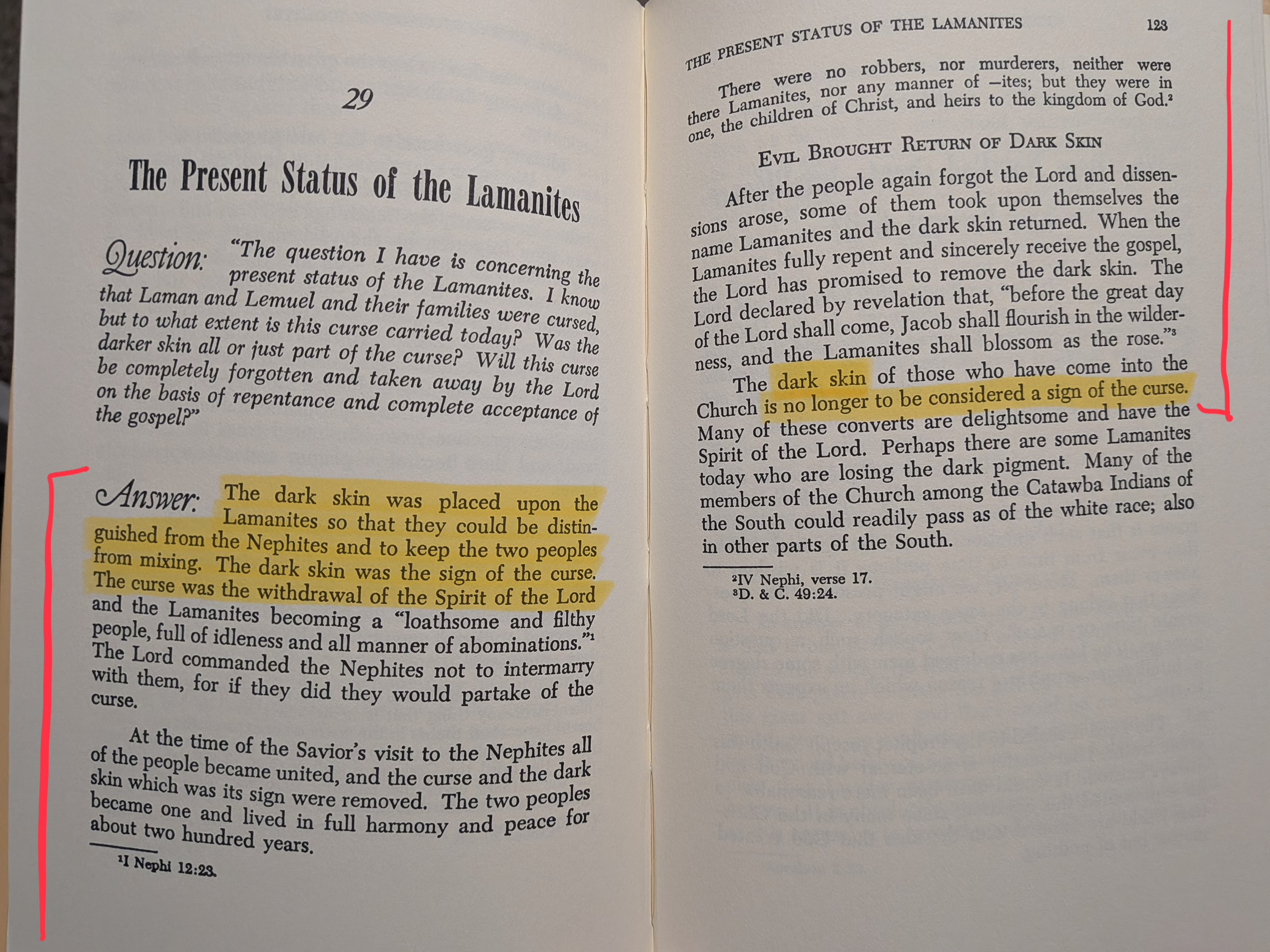
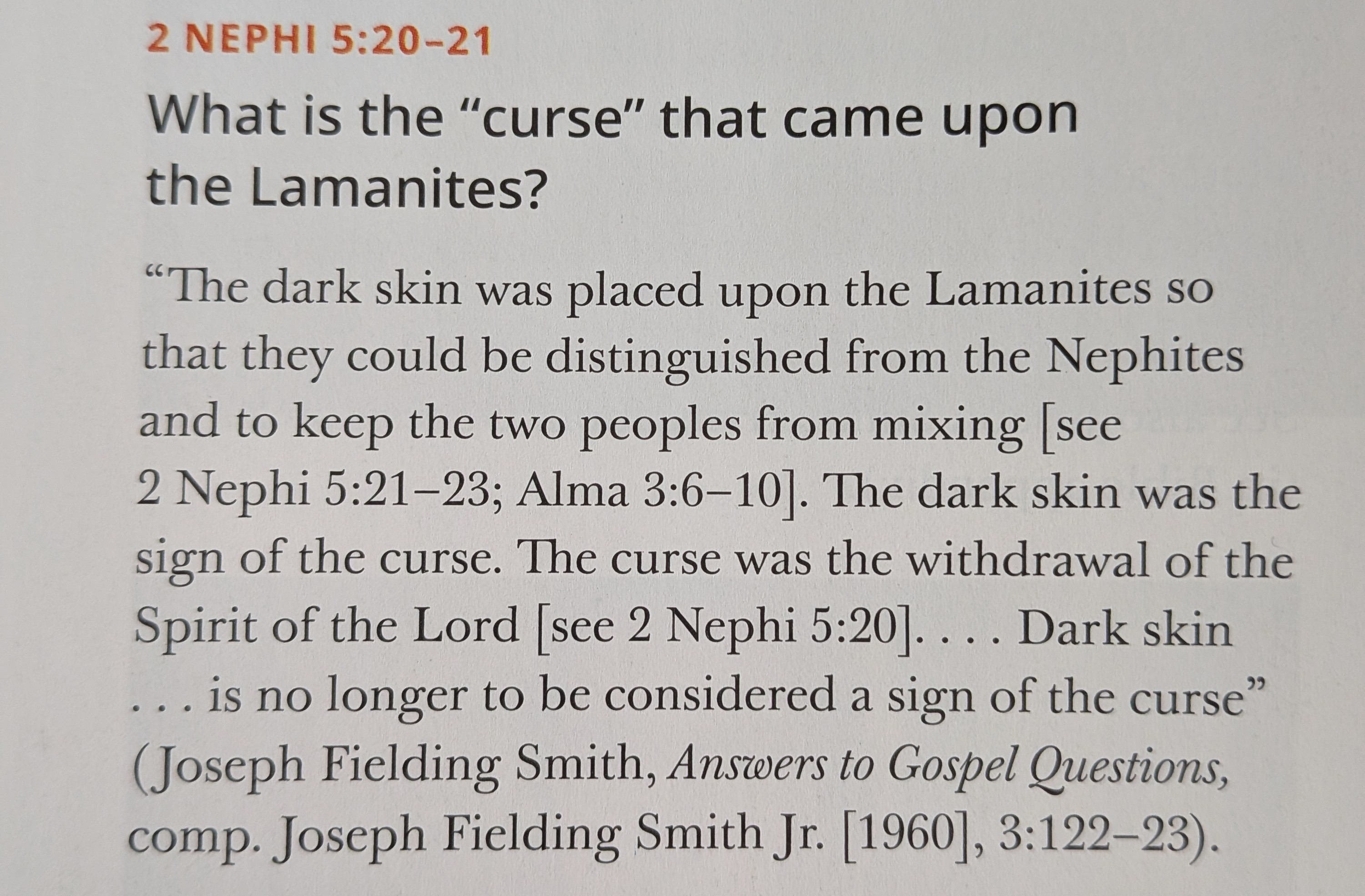
The "Come Follow Me - Book of Mormon 2020" manual, covering 2 Nephi 5, originally quoted Joseph Fielding Smith discussing the curse of the Lamanites. The quote addressed skin color as the sign of the curse (while in the 1955 edition of the Book of Mormon, according to the chapter summary, the curse itself was the dark skin) and identified being cut off from the Lord as the consequence. The manual's quotation, however, was selective - quoting several paragraphs but stringing together multiple segments - altering its context. When members studying the manual noticed the quotation and investigated, the Church responded by removing the quot updating the digital version. The printed versions, however, had already been distributed and could not be recalled. Additionally, this method of quotation is misleading - it allows them to take any part of the original text they want and cut it up to say what they want.
| Quote | Lesson Manual |
|---|---|
 |
 |
Thoughts regarding the Book of Mormon
The Church needed to address the issues in the Book of Mormon. Instead of discussing and offering resolution, the Church simply modified the troubling content. This is academically and morally delinquent. These changes to introductions, chapter summaries, scripture wording, and teaching manuals - serve one purpose: to present the narrative the Church wants and potentially hide the historical record - eventually these changes will be forgotten. This prevents honest discussion. The Church does not trust members to come to the "correct" conclusions when presented with this material. Most importantly, it shows that the Church puts its reputation above historical honesty.
Chapter 3: Book of Abraham & Other Translations
The Book of Abraham is canonized and accepted as scripture, but there are questions about its authenticity. The following sources are helpful in this analysis:
- Sources
The Book of Abraham - is it a translation or revelation?
The introduction of the Book of Abraham claims it is a "translation" - it is a firm and clear statement. However, when reading the Gospel Topics essays, the essays address the issue that the book does match the now-translatable fragments of papyri - the essays suggest that the papyri were simply a catalyst for inspired revelation that Joseph then wrote. This argument feels like a huge stretch to protect the authenticity of the Book, especially considering the introduction specifically claims it is a translation. How can we be confident it isn't a fabrication - similar to other documented cases of fraudulent "ancient" documents that Joseph Smith or Church leaders accepted as real?
The Kinderhook Plates
Church History Topics | Kinderhook Plates - Joseph Smith declared the Kinderhook plates to be genuine ancient artifacts and claimed to translate characters from them. These plates were later proven to be 19th-century fakes. This raises a key question about Joseph Smith's gift of translation: Did he have genuine prophetic discernment to tell authentic ancient records from fakes, or not? If he could be fooled by the Kinderhook plates, how much confidence can we place in his translation of other supposedly ancient texts?
The Hofmann Forgeries
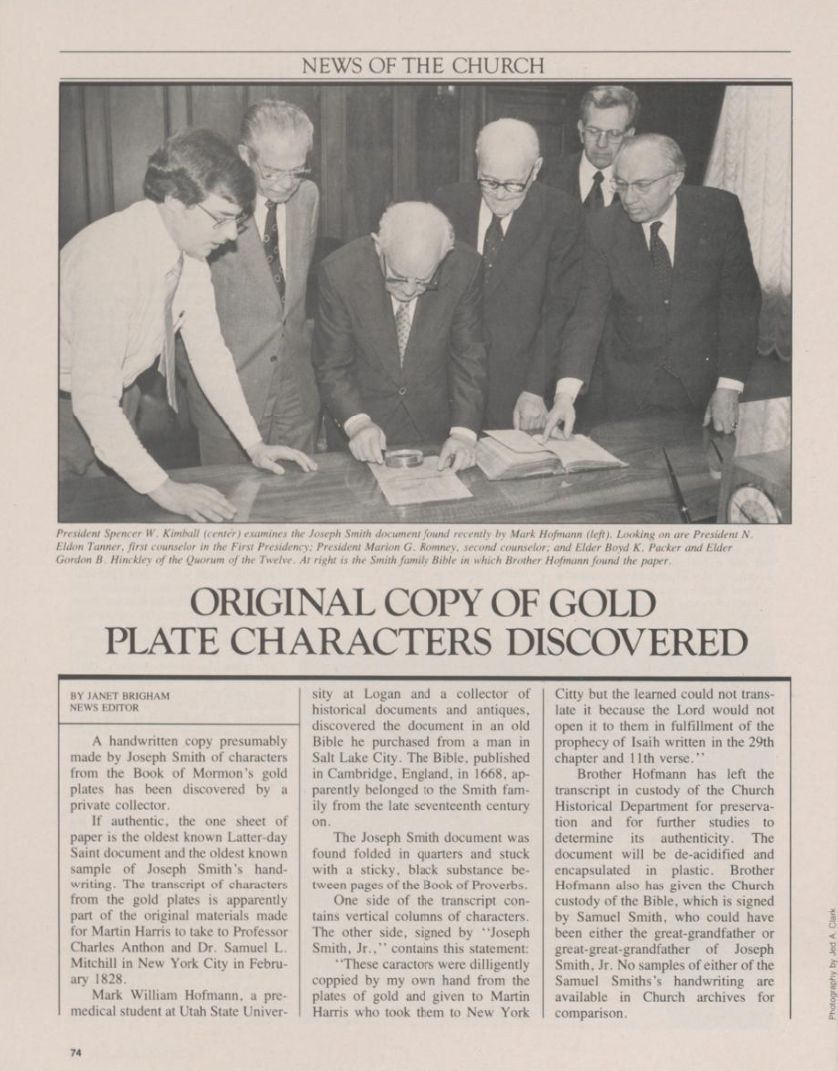
Church History Topics | Hofmann Forgeries - The Hofmann forgeries are very troubling. In the 1980s, Mark Hofmann deceived the First Presidency and other senior Church leaders into buying supposedly ancient documents, which he had actually manufactured himself. These men - sustained as prophets, seers, and revelators - couldn't tell the documents were fake. The spirit of discernment, for the Prophet was apparently not active during these interactions. The Church, believing the documents were real, even published articles in the Ensign about the discoveries. After the fraud was discovered and the church was embarrassed by the announcement, they quietly removed those articles from the digital Gospel Library, trying to hide the embarrassment from history.
| Ensign - Printed | Gospel Library - Digital |
|---|---|
 |
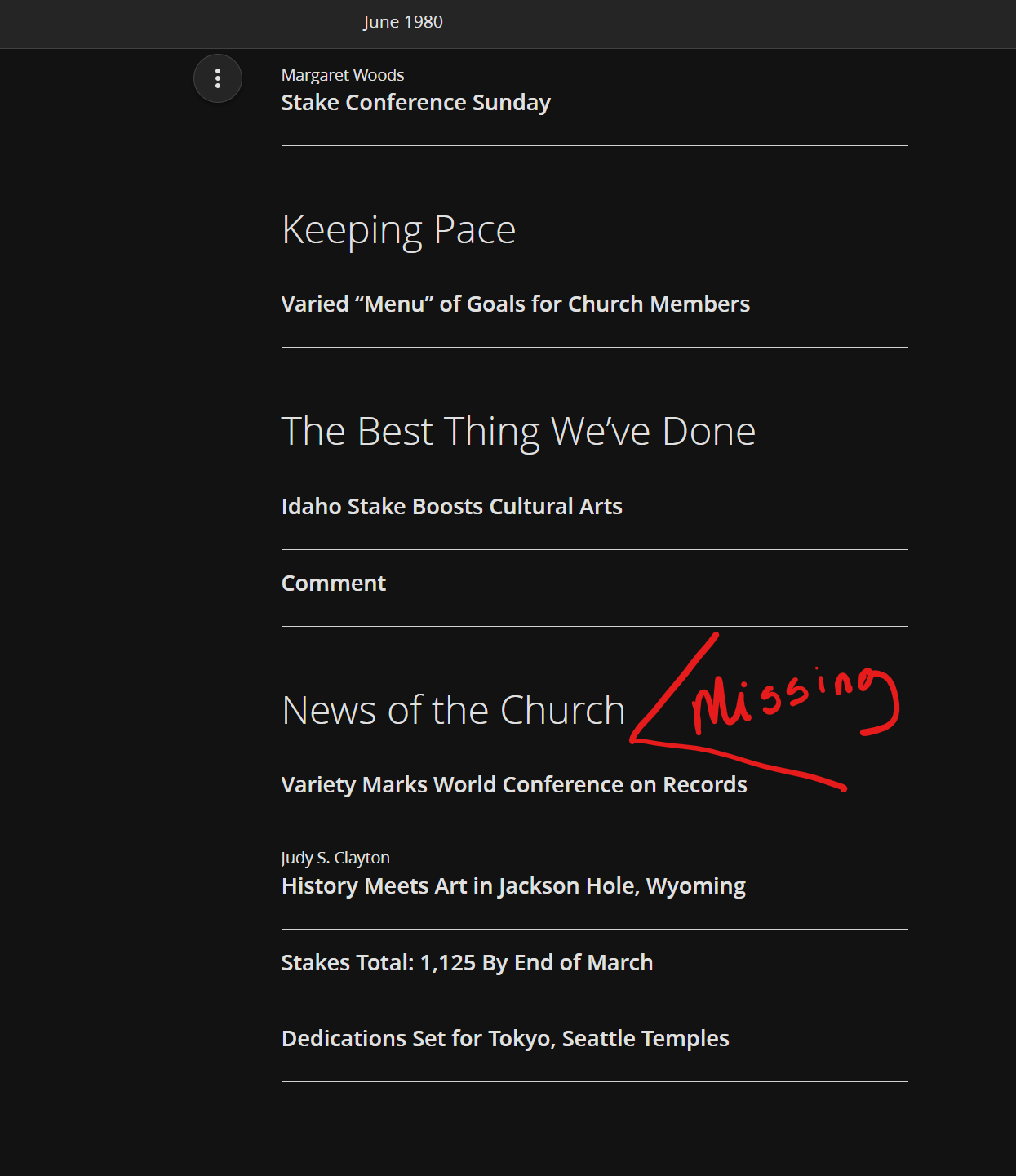 |
Source: Church History Catalog. The June 1980 Ensign contains an article titled "Original Copy of Gold Plate Characters Discovered" in the "News of the Church" section. This article doesn't appear in the Gospel Library's digital edition of the Ensign. It's only accessible in printed copies or in PDF-scanned archives that lack text-search functionality, meaning searches for "Hofmann" won't find it. Deliberately removing this article from the official digital library while keeping it in an unsearchable archive is a calculated effort to rewrite the historical record. This shows that honest engagement with Church history requires going beyond official Church resources - precisely the kind of independent research that Church leaders have discouraged (President Oaks Counsels Young Couples Defending the Gospel on the Frontline - Newsroom - February 2019).
Thoughts regarding the Book of Abraham
The Church has rejected the Kinderhook Plates and acknowledged the Hofmann forgeries as fakes. Both show failures of prophetic discernment. Regarding the Book of Abraham, I would suggest that Joseph Smith, anxious to justify his purchase of the mummies and papyri, worked to deliver something/anything that would further support his position as prophet. The resulting Book of Abraham lacks authenticity: the official introduction claims translation, while the Gospel Topics Essays back away from that claim. The Kinderhook Plates and Hofmann forgeries were rejected as inauthentic, and the Book of Abraham lacks credability. I do not accept any of them as authentic.
Chapter 4: Race
Until 1978, the Church prevented Black members from holding the priesthood or receiving temple ordinances. This meant Black families couldn't be sealed together for eternity - denying them access to the Church's highest promised blessings. The doctrinal and scriptural justifications for this were taught by prophets and apostles for over a century. These weren't presented as opinions or policies open to change, but as divine truth from God.
The Church's Current Position
The Church now tries to distance itself from these teachings through a single sentence in its Gospel Topics Essay: "The Church disavows the theories advanced in the past that black skin is a sign of divine disfavor or curse" (Gospel Topics Essay | Race and the Priesthood). This raises questions. Did those leaders teach their opinions? Does this "disavowal" extend to scriptural passages like 2 Nephi 5:21, which explicitly describes dark skin as a curse from God? The Church also changed 2 Nephi 30:6 from "white and delightsome" to "pure and delightsome" - another example of revising the text rather than honestly addressing it.
Theories
The Church disavows the "theories" - a theory is just an idea, or an opinion, until it has been proven. Because the Church labels racial restrictions as "theory", it shows a historical pattern of the Church (leaders, doctrine, policy, etc.) teaching and endorsing opinion as doctrine for 150 years. However, Elder Renlund taught "Ever since God appointed prophets, they have been authorized to speak on His behalf. But they do not pronounce doctrines fabricated "of [their] own mind" or teach what has not been revealed." So who is lying? This statement by the Church is wrong, dishonest, and misleading.
The Church “Disavows” the Theories Taught by Prophets
The word "disavow" in the essay was deliberately chosen to minimize accountability. By calling these teachings "theories," the Church tries to suggest they were just speculative ideas rather than established doctrine taught by prophets in their official capacity. That's historically inaccurate. For over 150 years, prophets and apostles taught these racial doctrines as divine revelation. The priesthood restriction wasn't presented as a "theory" - it was enforced as binding Church policy with eternal consequences.
The priesthood ban meant more than being excluded from Church leadership. It prevented Black members from receiving temple endowments, from being sealed to their spouses, and from having their children sealed to them. According to Latter-Day Saint theology, these ordinances are essential for exaltation. The Church explicitly taught that Black members were denied these blessings because of a divine curse - a teaching the Church now dismisses as mere "theory" without acknowledging the real harm it caused.
Thoughts regarding Race and the Priesthood
If these teachings are wrong now, they were wrong then. Moral truth doesn't change based on cultural pressure or social movements. The Church's leadership either received revelation from God establishing these exclusionary policies, or they taught their own prejudices as divine doctrine. If the former, then God condemned generations and excluded them from the temple, simply because they were born black. If the latter, the prophets couldn't tell the difference between their personal opinions and God's will. Either conclusion is a wrong.
The way the Church has managed this issue - through a quiet "disavowal" buried in an essay rather than a formal acknowledgment and real apology - shows a pattern of protecting institutional reputation at the cost of honesty. The word "disavow" isn't enough. What's needed is an acknowledgment that prophets taught their opinions as divine truth for over a century, causing lasting harm to Black members and their families. I do not accept their disavowal.
Chapter 5: Baptism of Children of Same-Sex Couples
In 2015, the Church put in place a policy preventing children of same-sex couples from being baptized. This policy was presented as revelation from God, and it was explained that it was to protect children from being caught between conflicting teachings at home and at church. In 2019, after significant public criticism and internal pushback, the Church reversed it. This episode raises real questions about the nature of revelation and prophetic authority.
Sources
- CBS | Mormon Church Issues Rules Aimed at Gay Members and Their Kids
- LDS Newsroom | Love Motivated Policy Changes Toward LGBT Parents Children
- CBS | Mormon Church LGBT Policy - Mormon Church Now Allowing Children of LGBTQ Parents to be Baptized
- LDS Newsroom | Elder Christofferson: Context on Handbook Changes Affecting Same-Sex Marriages
The Stated Justification
President Nelson explained the 2015 policy: "We wanted to facilitate harmony in the home and avoid pitting children and parents against each other." This justification doesn't hold up against existing Church policy. Children of non-member parents can be baptized with parental permission. Children of parents who actively oppose the Church can be baptized with parental permission. Children of parents living contrary to Church teachings can be baptized with parental permission. No policy restricts these children from baptism based on their parents' circumstances - only parental approval is required.
The concern about "pitting children against parents" applies equally to any situation where parents' beliefs differ from Church teachings. Yet no special policy was created for children of atheist parents, children of parents in polygamous relationships, or children of parents who openly criticize the Church. The policy singled out same-sex couples, suggesting the real motivation was different from what was stated.
The Scriptural Standard
Christ's teaching is unambiguous: "Suffer little children to come unto me, and forbid them not: for of such is the kingdom of God" (Luke 18:15-16). The 2015 policy directly contradicted this principle, forbidding children from coming to Christ through baptism based on their parents' relationship. There's no way to reconcile that with Christ's explicit instruction not to forbid children.
The Reversal
In 2019, the Church reversed the policy. If the original 2015 policy came through revelation, why reverse it only 4 years later? Does revelation from God need to be tested and then corrected? The pattern looks like this: a policy was introduced, proved problematic both practically and theologically, was criticized, and then reversed - which sounds a lot more like an institutional mistake than divine revelation.
Thoughts regarding this policy
This episode shows that Church leaders put policies in place - presenting them as inspired or revealed - and then reversed them under social. The policy had no doctrinal foundation, directly contradicted Christ's teachings about children, and was eventually dropped. The four years this policy stayed in effect represent a real failure of prophetic leadership, with real consequences for the families and children it affected. This is a disgusting and hurtful. The leadership of the Church should be ashamed for creating and supporting this policy. If anyone disregards this episode as "just a policy," then they are willfully ignoring Oaks teaching regarding policy vs doctrine.
Chapter 6: Prophets
In the April 2023 General Conference, a member of the Seventy taught: "Brothers and sisters, unlike vintage comic books and classic cars, prophetic teachings do not become more valuable with age. That is why we should not seek to use the words of past prophets to dismiss the teachings of living prophets" (A Living Prophet for the Latter Days | Allen D. Haynie | April 2023). This statement acknowledges an uncomfortable reality: prophets contradict each other. If prophetic teachings were consistent expressions of eternal truth, no such disclaimer would be necessary. The fact that members need to be warned not to rely on past prophetic statements reveals that the Church knows there are real inconsistencies in prophetic teaching over time.
Using the name “Mormon” is a victory for Satan
The evolution of Church teaching regarding its own name provides a clear example of prophetic contradiction spanning decades.
In April 1990, then-Apostle Russell M. Nelson taught that members should not use nicknames such as "Mormon" for the name of the Church (Thus Shall My Church Be Called | Russell M. Nelson | April 1990). Six months later, President Gordon B. Hinckley (then First Counselor in the First Presidency) taught that calling ourselves "Mormon" was acceptable because it was simply a nickname, and suggested that "Mormon" meant "more good" (Mormon Should Mean 'More Good' | Gordon B. Hinckley | October 1990).
President Thomas S. Monson continued this theme in October 2011, declaring "Dare to be a Mormon; Dare to stand alone" (Dare to Stand Alone | Thomas S. Monson | October 2011). Under Presidents Hinckley and Monson, the Church invested millions of dollars in the "I'm a Mormon" marketing campaign, producing videos, websites, and promotional materials emphasizing the Mormon identity.
Then, in October 2018, President Russell M. Nelson - serving as President of the Church - declared that using the name "Mormon" to identify the Church represents "a major victory for Satan" (The Correct Name of the Church | Russell M. Nelson | October 2018). This change directly contradicts the teachings of Presidents Hinckley and Monson. If using "Mormon" constitutes a victory for Satan, then the previous prophets' teachings and the Church's multi-million dollar "I'm a Mormon" campaign were advancing Satan's purposes. If Presidents Hinckley and Monson were correct, then President Nelson's characterization is an overreaction.
This condemnation forced an aggressive, expensive overnight rebranding of the Mormon Tabernacle Choir, Mormon.org, and auxiliary assets. The lingering discomfort with this shift remains evident; as recently as the October 2025 General Conference, Elder Valeri V. Cuvelier of the Seventy lightheartedly noted an old Church pamphlet titled What do you know about the Mormons? before quickly adding the defensive disclaimer, "I'm certain that title has changed" (The Name by Which Ye Are Called | Valeri V. Cuvelier | October 2025).
The question is unavoidable: Which prophets were telling the truth? The answer can't be "all of them," because their teachings directly contradict each other. For thirty years, Church leaders promoted, defended, and celebrated the Mormon identity. Then, suddenly, that same identity became Satanic. This isn't consistent prophetic guidance - it's changing institutional preferences being presented as divine truth.
The Adam-God Doctrine
Brigham Young taught that Adam was God the Father (Adam-God Doctrine | Wikipedia). He declared that God descended to earth with one of his wives, Eve, to begin the human race. This teaching was significant enough that elements of it were incorporated into the temple endowment ceremony during Brigham Young's tenure.
After Brigham Young's death, subsequent Church leaders disavowed this doctrine, characterizing it as Brigham Young's personal opinion rather than official doctrine (Our Own Liahona | Spencer W. Kimball | October 1976) (also see Adam–God Theory in the Temple | FAIR). The teaching was removed from the temple ceremony.
This raises real questions. Did Brigham Young teach this doctrine in his capacity as prophet, or as a private individual? If as prophet, then God revealed false doctrine through His chosen prophet. If as a private individual, why was it incorporated into sacred temple ceremonies? How are members supposed to tell the difference between prophetic teaching and personal opinion when both come from the same pulpit with the same authority?
Opinion vs. Doctrine
In the April 2022 General Conference, Elder Dale G. Renlund taught "Ever since God appointed prophets, they have been authorized to speak on His behalf. But they do not pronounce doctrines fabricated "of [their] own mind" or teach what has not been revealed." (Your Divine Nature and Eternal Destiny | Dale G. Renlund | April 2022). This statement is demonstrably false and directly contradicts the Church's own explanation for discontinued teachings and policies (Yes, policies - President Oaks said that in a Church guided by a prophet, policy and doctrine are the same). The Church has labeled various past prophetic teachings as "opinion" or "theory" once those teachings became unsustainable:
- The Adam-God doctrine (dismissed as Brigham Young's opinion)
- Racial teachings justifying the priesthood ban (dismissed as "theories")
- The "I'm a Mormon" campaign (implicitly dismissed through policy reversal)
- Modification of policy or guidance regarding tattoos, multiple piercings, birth control, masturbation, women holding jobs, white shirts required by Deacons when passing sacrament, etc.
If prophets don't teach their own opinions, then all these teachings were divine revelation and should still be binding today. If they do teach their own opinions, then Elder Renlund's statement is false, and members have no reliable way to tell inspired teaching from personal speculation.
The temple ceremony formerly warned against the "philosophies of men, mingled with scripture." This phrase has since been removed from the endowment. Yet this phrase accurately describes the pattern of prophetic teaching when doctrines are later dismissed as opinion: human philosophy, supported by selective use of scripture, presented as divine truth.
When the Prophet speaks the debate is over
A widely taught principle states: "When the prophet speaks, the debate is over" (If We Want to Go Up, We Have to Get On | Elaine Cannon | October 1978). Yet prophets regularly restart debates by contradicting their predecessors. President Nelson's reversal on the "Mormon" identity reopened a debate President Hinckley had closed. Official Declaration 2 (1978) reversed the priesthood ban that previous prophets had defended as divinely mandated. The 2019 policy reversal on children of same-sex couples undid the 2015 policy.
If debate ends when the prophet speaks, which prophet ends it? The pattern shows that prophets frequently reverse, modify, or disavow their predecessors' teachings. This makes "when the prophet speaks, the debate is over" practically meaningless. The debate may pause, but it reopens with the next prophet.
Examples of Wrong Teachings
The list of teachings once presented as divine truth but later abandoned includes:
- Polygamy (once required for exaltation, now grounds for excommunication)
- Racial teachings justifying the priesthood ban (disavowed as "theories")
- Adam-God doctrine (dismissed as opinion)
- The "Ponderize" campaign (LDS Church Leader Apologized for Ponderize Merchandise Website | KUTV) - Kevin G. Durant gave a General Conference talk in October 2015 coining the term "ponderize." Prior to the conference, the ponderize domain had been bought and merchandise had been created. His family was actively participating in this. The commercial motivation undermined the spiritual message.
- Paul H. Dunn's faith-promoting stories (Paul H. Dunn | Wikipedia) - A General Authority who told fabricated faith-promoting stories for years before being forced to apologize for the deception.
Each of these examples shows that prophetic teaching and authority are fallible. Some might say that prophets are human and make mistakes. That may be true, but it fundamentally undermines the Church's claims about prophetic authority and continuing revelation.
Prophetic Compensation and Merchandising
Ancient apostles and prophets were not salaried employees. Christ sent His disciples forth with specific instructions: "Freely ye have received, freely give" (Matthew 10:8). Yet General Authorities receive what the Church describes as a "modest living allowance" (FAQ | lds.org | Do General Authorities Get Paid).
Additionally, General Authorities write and publish religious books for profit. Members often buy these books because they're written by prophets and apostles. Selling spiritual authority for a price is inconsistent with Christ's instruction to His apostles. The inspired words of prophets are now available for $19.95 at Deseret Book! #sarcasm
Criticizing Church Leaders
Dallin H. Oaks taught that members should not criticize Church leaders, even if the criticism is true (Criticism | Dallin H. Oaks | Ensign February 1987). This teaching puts prophets and apostles above accountability. Yet accountability is essential in any leadership structure. When leaders can't be criticized - even when the criticism is factually accurate - errors and abuses go uncorrected. This teaching protects institutional power, not truth.
Thoughts regarding Prophets
Despite prophets teaching that prophets don't teach their opinions, they have clearly taught their opinion and instituted policies that are wrong. They are inconsistent and contradictory. Prophets do teach their opinions, present them as divine truth, and then later prophets contradict or disavow those teachings. There is nothing special about the prophets and other leadership of the Church - they teach, speak, and do the same as everyone else. If they had a special conduit to God, then teachings would never need to be be corrected or disavowed.
Chapter 7: Joseph Smith
Joseph Smith's teachings and actions around accountability, sin, and polygamy raise serious concerns about his prophetic authority and character. Two issues stand out as especially troubling: his teaching that sin is connected to accusation rather than the act itself, and his secret correspondence about plural marriage.
Accountability and Accusation
In a discourse delivered November 7, 1841, Joseph Smith taught: "If you do not accuse each other, God will not accuse you. If you have no accuser you will enter heaven; and if you will follow the Revelations and instructions which God gives you through me, I will take you into heaven as my back load. If you will not accuse me, I will not accuse you. If you will throw a cloak of charity over my sins, I will over yours - for charity covereth a multitude of sins. What many people call sin is not sin" (Joseph Smith Papers | Nov 7 1841).
This teaching fundamentally contradicts the idea of personal accountability. According to Joseph Smith, punishment for sin depends on whether someone accuses and reports you - not on the sin itself. This conflicts with basic Latter-Day Saint theology that sin is sin regardless of whether anyone knows about it. The real-world implications of this teaching became clear.
Early Latter-Day Saint women later testified about how certain men twisted Joseph Smith's words to justify sexual misconduct. The Joseph Smith Papers note: "Aside from John C. Bennett, the accused men included Chauncey L. Higbee, Lyman O. Littlefield, Joel S. Miles, and Gustavus Hills; Catherine Fuller Warren also testified that William Smith, brother of JS, 'proposed unlawful connexion but I refused him.' Some of these men may have twisted words from JS's 7 November 1841 discourse, which reportedly stated that 'if we did not accuse one another God would not accuse us & if we had no accuser we should enter heaven.' Some of the women who later testified before the Nauvoo high council indicated that these men told them that there was no sin in what they were doing if the relationship was kept secret, because there could be no accuser" (Joseph Smith Papers | March 31 1842 | Letter to Emma Smith & Relief Society | Footnote 8)).
Joseph Smith taught this principle in his capacity as prophet. The teaching is clear: if no one accuses you, God will not accuse you. That's not how morality works. Wrong is wrong whether or not you're caught. Joseph Smith's teaching here was fundamentally flawed.
The Letter to the Whitneys
In August 1842, while in hiding, Joseph Smith wrote a letter to Newel K. Whitney, Elizabeth Ann Whitney, and their daughter Sarah Ann Whitney (Joseph Smith Papers | Letter to the Whitneys | Aug 18 1842). Sarah Ann was one of Joseph Smith's plural wives. In this letter, Joseph requested that Sarah Ann visit him secretly. He explicitly instructed them not to visit if Emma was present, asked them to burn the letter, and emphasized that the visit must be kept secret.
Several questions arise from this correspondence:
- Why did Joseph Smith need to meet Sarah Ann in secret?
- Why was it necessary to keep this from Emma?
- If Joseph Smith was following God's commandments in practicing plural marriage, why did secrecy from Emma matter?
- Why did he ask for the letter to be burned?
The secrecy contradicts the claim that Joseph Smith's plural marriages were conducted under divine commandment. God's commandments don't require deceiving your spouse. The letter shows Joseph Smith was deliberately hiding his plural marriage activities from Emma - suggesting he knew she would object and that he knew his behavior was wrong.
Fanny Alger
Joseph Smith's first plural wife was Fanny Alger, whom he married in the mid-1830s (Church History Topics | Fanny Alger). This and other relationships predate the 1843 revelation on plural marriage recorded in D&C 132. Oliver Cowdery accused Joseph Smith of adultery concerning Fanny Alger. This accusation led to Oliver Cowdery's excommunication - not for making false accusations, but for refusing to recant what he knew to be true.
If plural marriage was commanded by God, why did Joseph Smith begin practicing it years before the revelation was recorded? Why was it done in secret? Why was Oliver Cowdery punished for calling it adultery? The sequence of events suggests that Joseph Smith was in a relationship with Fanny Alger, got accused of adultery, and then developed theological justifications for plural marriage to retroactively legitimize what he'd done.
Thoughts regarding Joseph Smith
Joseph Smith said and did a lot of things that were wrong and immoral. He didn’t follow his revelations, and he lied and was secretive. Defenders of the Church and Joseph will claim he was just a man and therefore imperfect. I agree - he was imperfect, but that doesn’t excuse his actions. Joseph Smith's teaching that accountability depends on accusation rather than action is morally indefensible. His secret letter about Sarah Ann Whitney shows deliberate deception. His relationship with Fanny Alger predates any claimed revelation authorizing plural marriage. These things raise serious questions about Joseph Smith's prophetic calling and integrity. A prophet of God should model moral clarity and honesty, not teach principles that undermine accountability and engage in deception. His actions are not the actions of a prophet.
Chapter 8: Polygamy
The history of polygamy in The Church of Jesus Christ of Latter-Day Saints shows deep inconsistencies between stated doctrine, actual practice, and scriptural teaching. The primary revelation on plural marriage, D&C 132, sets specific requirements and justifications for the practice. Yet Joseph Smith and later Church leaders repeatedly violated those requirements. This pattern shows that polygamy was not practiced according to divine mandate but according to human desire.
Using biographical and timeline data from History.ChurchOfJesusChrist.org, I have compiled a table of the wives of Joseph Smith. It is helpful when discussing Joseph Smith and Polygamy.
The Stated Purpose
D&C 132:63 identifies the primary purpose of plural marriage: to "multiply and replenish the earth" and "bear the souls of men." The entire section provides the framework for understanding why plural marriage was commanded. The preceding verse (D&C 132:61) explicitly discuss criteria for taking "another wife." Therefore, verse 63 serves as justification for polygamy as a means to produce children.
Any argument suggesting that Joseph Smith's plural marriages didn't include a sexual component contradicts the stated purpose of the revelation. If plural marriage was commanded for procreation, and Joseph Smith's plural marriages didn't serve that purpose, then Joseph Smith wasn't following the divine mandate he claimed to have received.
In the Church's Gospel Topics essay on plural marriage, the authors attempt to justify Joseph Smith's marriage to Helen Mar Kimball by asserting there was no sexual relationship - implying the relationship did not follow the mandate of polygamy found in D&C 132. The essay's phrasing that the marriage occurred "...several months before her 15th birthday" is notable for avoiding the more direct statement that "she was only 14." That word choice was clearly meant to soften a troubling part of the historical record.
The Law of Sarah
D&C 132:61 lays out requirements for taking a plural wife: the woman must be a virgin, and the first wife must consent. But D&C 132:65 provides an exception: if the first wife doesn't accept polygamy, her husband is exempt from the Law of Sarah and free to take additional wives without her consent. This "exception" cancels the requirement entirely. It's not consent when refusal is overridden. This provision serves one purpose: to provide theological cover for proceeding with plural marriage regardless of the first wife's objections.
Joseph Smith violated these requirements. He took wives who were not virgins. He took wives without Emma's knowledge or consent. Many of his plural marriages occurred in secret, directly contradicting the "divine" mandate.
Scriptural Contradictions
D&C 132:1 justifies plural marriage by citing Old Testament prophets: Abraham, Isaac, Jacob, Moses, David, and Solomon were justified in taking multiple wives. Yet the Book of Mormon - written before the Doctrine and Covenants - explicitly contradicts this claim: "Behold, David and Solomon truly had many wives and concubines, which thing was abominable before me, saith the Lord" (Jacob 2:24).
The Book of Mormon condemns David and Solomon for polygamy. The Doctrine and Covenants justifies their polygamy. Both can't be right. This isn't a minor inconsistency - it's God condemning an act in one scripture and justifying the same act in another scripture about the same people.
Jacob 2:27 states that a man should have only one wife, but Jacob 2:30 adds that God may command plural marriage if He chooses. The critical question remains: Did God ever actually command Old Testament prophets to practice polygamy? The biblical record shows men having multiple wives but gives no record of God commanding this practice. Concerning Abraham, Genesis shows that Sarah (not God) instructed Abraham to take her handmaid Hagar (Genesis 16:1-2). The polygamy of Old Testament figures appears to be permitted or tolerated, not commanded - making the justification in D&C 132 historically unfounded.
The Timeline
Joseph Smith married Emma in 1827. Their marriage was "for time only" because the sealing power had not been restored. Eventually they were sealed on May 28, 1843. This timeline reveals that Joseph Smith was married and sealed to over twenty other women before Emma was sealed to him. Emma should have been first. Many of these women were sealed to Joseph without Emma's knowledge or approval, violating the "Law of Sarah" outlined in D&C 132:61. Taking multiple wives, without following this law, was adultery (D&C 132:62) - Emma was unaware of and did not accept polygamy at first; does this imply that some of Joseph's marriages constituted adultery?
The Joseph Smith Papers document one particularly egregious example: "Emma Smith struggled with JS's new marriages in the months leading up to July 1843. Since the beginning of 1843, JS was sealed to at least thirteen additional wives, most of whom were married to him without Emma's knowledge. Although details regarding Emma's reactions to JS's practice of plural marriage prior to 1843 are scarce, she evidently came to accept the doctrine, albeit temporarily, by May of that year, on the condition that she could choose the women to whom JS would be sealed. That month, she selected Eliza and Emily Partridge, who were then ages twenty-three and nineteen and living in the Smith household, as potential marriage partners to JS. In fact, JS had already been sealed to the sisters two months earlier. JS and the Partridge sisters sought to avoid confrontation by repeating the marriages, with Emma's blessing, as if for the first time. Likely during the same month, Emma suggested JS marry Maria and Sarah Lawrence, ages nineteen and sixteen or seventeen, another pair of sisters who were living in the Smith household. However, Emily Partridge later testified that Emma became embittered "soon after" the Partridge sisters' second wedding ceremony. By the end of June, JS's scribe William Clayton noted, Emma was treating JS "coldly & badly" and "was disposed to be revenged on him," saying "she thought that if he would indulge himself she would too." (Joseph Smith Papers - Revelation, 12 July 1843 and JS Sealed Again to Emily and Eliza Partridge).
Joseph Smith was married to the Partridge sisters in secret. When Emma later selected them as plural wives, Joseph and the sisters went through a second ceremony to create the appearance of consent. That level of deception - from all parties involved - cannot be reconciled with integrity. This was dishonest and wrong.
Lying for the Lord
Secretly, Joseph Smith began practicing polygamy many years before the 1843 revelation. His first plural wife was Fanny Alger in the mid-1830s (Gospel Topics Essays | Plural Marriage in Kirtland and Nauvoo and Church History Topics | Joseph Smith Wife: Fanny Alger). Oliver Cowdery accused Joseph of adultery, leading to Oliver's excommunication.
In 1844, Joseph Smith publicly stated: "What a thing it is for a man to be accused of committing adultery and having seven wives when I can only find one" (Joseph Smith Papers | 1844). At the time of this statement, Joseph had over thirty wives. This was a deliberate lie. Some try to justify this as "lying for the Lord" - lying to protect sacred truths from those not ready to receive them. But if polygamy was right and commanded by God, why lie about it? If it was truly commanded, Joseph should have proclaimed it openly and accepted the consequences.
Brigham Young and Celestial Requirements
Brigham Young taught that plural marriage was required for exaltation in the celestial kingdom: "The only men who become Gods, even the Sons of God, are those who enter into polygamy. Others attain unto a glory and may even be permitted to come into the presence of the Father and the Son; but they cannot reign as kings in glory, because they had blessings offered unto them, and they refused to accept them" (Journal of Discourses, Vol. 11, Pages 268-269, Brigham Young - August 19 1866).
If Brigham Young spoke as a prophet - and the Church teaches that prophets speak for God - then this teaching represents divine truth. Yet the Church now practices monogamy and excommunicates members who practice polygamy. If Brigham Young was right, then every monogamous Latter-Day Saint is excluded from the highest degree of celestial glory. If he was wrong, then he taught false doctrine as prophetic truth for decades.
Thoughts regarding Polygamy
Polygamy in early Mormonism can't be reconciled with the stated requirements in D&C 132. Joseph Smith violated the "Law of Sarah," married women without Emma's knowledge, and lied publicly about his marriages. The scriptural justifications contradict the Book of Mormon. Brigham Young taught that polygamy was required for exaltation, a doctrine the modern Church has abandoned. Polygamy was not practiced according to divine mandate but according to human desire, justified through selective theology and deception. I find the entire affair disgusting and wrong.
Polygamy Data for Joseph Smith
Based on the analysis of the Church History Biographical Database page for Joseph Smith Jr. and its associated profiles, here is a detailed table of the women he married.
The table includes the 30 women listed on the provided timeline, ordered by their marriage date to Joseph Smith as presented in the source. Ages are calculated based on the marriage date and birth date provided in the associated biographical profiles. Blank spaces in the table represent either no-data from the official church biographical database or not-applicable to that woman.
| No. | Her Name | Date of Marriage to Joseph | His Age | Her Age | Name of Existing or Previous Husband | Marriage Date to Previous Husband |
|---|---|---|---|---|---|---|
| 1 | Emma Hale Smith | 1827 January 18 | 21 | 22 | ||
| 2 | Fanny Alger | 1835 – 1836 | 29 | 17 | ||
| 3 | Louisa Beman* | 1841 April 5 | 35 | 26 | ||
| 4 | Zina D. H. Young* | 1841 October 27 | 35 | 20 | Henry Bailey Jacobs | 1841 March 7 |
| 5 | Presendia Lathrop Huntington | 1841 December 11 | 35 | 31 | Norman Oliver Buell | 1827 January 8 |
| 6 | Agnes Moulton Coolbrith | 1842 January 6 | 36 | 30 | Don Carlos Smith | 1835 July 30 |
| 7 | Mary Elizabeth Rollins* | 1842 February | 36 | 23 | Adam Lightner, Jr. | 1835 August 11 |
| 8 | Sylvia Porter Sessions | 1842 February 8 | 36 | 23 | Windsor Palmer Lyon | 1838 March |
| 9 | Patty Bartlett | 1842 March 9 | 36 | 47 | David Sessions III | 1812 June 29 |
| 10 | Marinda Nancy Johnson | 1842 – 1843 | 36 | 26 | Orson Hyde | 1834 September 4 |
| 11 | Eliza R. Snow* | 1842 June 29 | 36 | 38 | ||
| 12 | Delcena Didamia Johnson | 1842 July | 36 | 35 | Lyman Sherman | 1829 January 16 |
| 13 | Sarah Ann Whitney | 1842 July 27 | 36 | 17 | ||
| 14 | Martha McBride | 1842 August | 36 | 37 | Vinson Knight, Sr. | 1826 July 6 |
| 15 | Ruth Dagget Vose | 1843 February | 37 | 34 | Edward Sayers | 1841 January 23 |
| 16 | Flora Ann Woodward | 1843 Spring | 37 | |||
| 17 | Emily Dow Partridge* | 1843 March 4 | 37 | 19 | ||
| 18 | Eliza Maria Partridge | 1843 March 8 | 37 | 22 | ||
| 19 | Almera Woodward Johnson | 1843 April – May | 37 | |||
| 20 | Lucy Walker | 1843 May 1 | 37 | 17 | ||
| 21 | Sarah Lawrence | 1843 May | 37 | |||
| 22 | Maria Lawrence | 1843 May | 37 | |||
| 23 | Helen Mar Kimball | 1843 May | 37 | 14 | ||
| -- | Emma Hale Sealed to Joseph | 1843 May 28 | 37 | 38 | ||
| 24 | Elvira Annie Cowles | 1843 June 1 | 37 | 29 | Jonathan Harriman Holmes | 1842 December 1 |
| 25 | Rhoda Richards* | 1843 June 12 | 37 | 58 | ||
| -- | D&C 132 - Revelation on Polygamy Revealed | 1843 July 12 | 37 | |||
| 26 | Desdemona Wadsworth Fullmer | 1843 July | 37 | |||
| 27 | Olive Grey Frost* | 1843 Summer | 37 | |||
| 28 | Melissa Lott | 1843 September 20 | 37 | |||
| 29 | Hannah Ells | 1843 – 1844 | 37 | |||
| 30 | Fanny Young | 1843 November 2 | 37 | 55 | Roswell Murray | 1832 |
* Women who later married Brigham Young - implying that Brigham also violated the Law of Sarah by marrying a "non-virgin" in a polygamous marriage.
Chapter 9: Garments
The Church's own treatment of garments shows that standards change to accommodate cultural trends rather than to reflect unchanging divine principles. The Church teaches that garments are an "outward expression of your inner commitment" to follow Christ (Church Handbook 38.5.5 | Wearing the garment).
The Pattern of Change
During temple recommend interviews, members are instructed not to modify the garment. The implication is clear: the garment's design reflects sacred and unchanging principles. Yet the Church itself has made numerous changes to garment design and usage over time. The often-taught principle - that when the world changes their standards, you can be sure the Lord's standards will never change - is directly contradicted by the actual history of garment modifications:
- It is now approved to wear a bra and underwear under the garments. Why was this not allowed before?
- Unacceptable answers include: "Was it not allowed?" or "That's just what we did."
- Members were once able to make garments at home, but this is no longer permitted. What prompted this change?
- Garments originally had full-length sleeves and legs, but modern shorts and t-shirts are now available. Why did this shift occur?
- In 2024–2025, sleeveless (tank-top) styles were introduced. This undermines the standard that clothing must have sleeves in order to be modest and to cover the garment.
- In 2025 some women were going crazy on social media because they would now be allowed to wear tank tops! This change in standards is glaring.
- There are now many styles for sale.
The Implications
For decades, clothing choices were shaped by the need to "cover the garment." Sleeveless clothing was considered immodest because it exposed garment-covered shoulders. Temple covenants about garment wearing were presented as unchanging divine requirements. As garments have become smaller - including the addition of sleeveless options - clothing styles that were once considered immodest are now acceptable.
This pattern shows that garment standards aren't anchored in eternal principles but are adjusted to match social and cultural trends. If the original full-length garments reflected divine requirements, what justifies abandoning them? If the modified, shorter, sleeveless garments are acceptable, then the original restrictive designs imposed unnecessary clothing standards on members.
Thoughts regarding Garments
Garments have always influenced clothing choices for Church members. Garments used to be wrist and ankle length, but then they shortened them - this pattern of modification has been repeated several times. We were taught our clothing should be modest, and cover our garments; example: no sleeveless clothing. With the introduction of sleeveless garments, members can now wear something that was previously “immodest”. That changing standard is troubling. So-called eternal morality standards should not variable or fluid.
Chapter 10: Temple
Out of respect for the Temple - these comments and questions reflect my personal observations and experiences.
The temple occupies a central place in Latter-Day Saint theology as the location where essential saving ordinances are performed. Yet looking at temple practices raises real questions about their necessity, consistency, and theological foundation.
Temple Recommend Interview
The temple recommend interview (General Handbook) is the Church's standard of worthiness. If you can honestly answer these questions, you are judged worthy to enter the temple. The questions trouble me: they don't assess whether you're living a Christ-like life; they measure commitment to the Church and conformity to the organization.
- Do you believe the Church was restored?
- Do you sustain your leaders?
- Do you support doctrines contrary to the Church?
- Do you attend Church regularly?
- Do you wear your garments?
- Do you follow the Word of Wisdom?
- Are you chaste?
- Do you pay your tithing?
- There are two questions about faith: "Do you have faith in God?" and "Do you have a testimony of the Atonement?"
The interview, in my view, should assess whether someone is a committed follower of Christ:
- Do you live a Christ-like life?
- Do you try to serve the sick?
- Do you try to care for the downtrodden?
- Do you love God and your fellow men?
Worthiness isn't just following these guidelines; it's living a life Christ would approve of - love, service, and compassion - not just church attendance, wearing specific underwear, or making monthly payments.
The Hebrew Temple and Christian Fulfillment
The Hebrew temple centered on animal sacrifice, which symbolized Christ's future atonement. These sacrifices pointed forward to the ultimate sacrifice that would render them obsolete. When Christ fulfilled the Law of Moses through His atonement, the need for animal sacrifice ended.
Christ's atonement fulfilled the Law of Moses and ended the necessity of temple sacrifice - but did it also end the necessity of the temple itself? Early Christians didn't build temples or perform temple ordinances. They met in homes and public spaces. The Book of Acts describes temple rituals, but those are the original Jewish rituals - continued to be practiced by the early Christians, which continued in the Jerusalem temple until its destruction in 70 AD (see Acts 2:46–47, Acts 3:1, Acts 21:26). There is no evidence that early Christians practiced anything resembling modern Latter-Day Saint temple ordinances. Additionally, when Christ was crucified, they record that the veil of the temple was rent - signifying the removal of the barrier between God and man, so was the temple necessary anymore? (Matt 27:51)
Signs and tokens - central to the modern LDS temple endowment - were not part of Hebrew temple worship. Ancient Hebrews and primitive Christians worshiped in the temple through sacrifice and did not receive the same "saving ordinances" performed in modern LDS temples. This raises a genuine question: Should modern temple work be performed for ancient Hebrews who participated in the original temple but never received endowments or sealings? If these ordinances are essential for salvation, then ancient covenant people were excluded from them.
The Pattern of Modification
Temple ceremonies and covenants aren't firm and eternal - they've been modified repeatedly throughout Church history. Each modification raises questions about the nature and authority of these supposedly sacred and unchanging ordinances:
- Left-shoulder/right-shoulder robe switch - Removed
- Standing and receiving tokens - Removed
- Covenant to avoid loud laughter - Removed
- The tie from the cap to the robe for men - Removed
- Requirement for women to veil their faces - Removed
- Covenant of "wife harkening" to husband - Removed
- Consequences for revealing the endowment - Removed from the presentation, but still apply?
- Dialog shortened - Multiple revisions for brevity
The Questions These Changes Raise
If these elements were part of the temple endowment as revealed by God, what justifies removing them? Were the original elements wrong or unnecessary? If they were unnecessary, why were they included in the first place? If they were necessary, why were they removed?
The removal of the "wife harkening" covenant - where women covenanted to follow their husbands as their husbands followed God - seems to align with modern views on gender equality. Yet temple covenants are presented as eternal, not subject to social trends. This change suggests the covenant was a product of nineteenth-century gender norms rather than eternal divine truth.
The removal of penalties for revealing the endowment - originally dramatic physical gestures symbolizing death - also appears to be a response to modern sensibilities rather than revelatory instruction. If these penalties were necessary parts of sacred covenants, removing them fundamentally alters the covenant. If they were not necessary, their inclusion for over a century raises questions about where temple ceremonies actually came from.
The Problem of Inconsistent Covenants
Do people who receive their endowment at different times make different covenants? Yes. Someone endowed in 1970 made covenants that someone endowed in 2025 does not make. If temple covenants are essential for exaltation, and these covenants have been modified, then either:
- Earlier members made unnecessary covenants, or
- Current members are not making all necessary covenants, or
- The covenants are not as fixed and eternal as represented.
None of these options supports the Church's claim that temple ordinances represent divine requirements.
Thoughts regarding the Temple
The temple serves as a symbol of Latter-Day Saint identity and commitment. But the historical record shows aspects of the temple have been repeatedly modified to match changing cultural norms and other preferences. The absence of comparable ordinances in early Christianity, the repeated changes to ceremonies presented as revealed truth, and the inconsistency of covenants over time all undermine the claim that temple ordinances represent unchanging divine requirements essential for salvation. The evidence suggests that temple practices are evolving institutional traditions rather than eternal divine mandates. I value the temple because it is where I was married - it represents a special beginning - but besides that it has no additional significance to me.
Chapter 11: Tithing
Preface: Tithing is found in the Old Testament, it is absent in the New Testament and Primitive Christianity. It was designed to support the institution - an institution that Christ superseded. The Church including tithing in modern times is wrong and not scripturally supported. The Church requires tithing be paid in order to be worthy of all blessings - this is ethically wrong and coercive.
- Sources
- Church Financial Administration
- Mark 12 (Render to Cæsar and Widow's Mite)
- Matthew 19:21 and Luke 18 (Rich ruler)
- Revelations in Context | The Tithing of My People
- Tithing and Fast Offerings | How are Tithing Funds Used
- Teachings of Joseph F Smith | Chapter 31
- D&C 119
- Widow's Mite Annual Report
History
Tithing is not unique to the LDS Church. Many other Christian churches collect tithing. Let's review the timeline of tithing in Christianity:
- Abraham and Pre-Law of Moses peoples practiced tithing, by supporting priests
- Tithing included in Law of Moses to support Levites
- Law of Moses fulfilled by Christ. No practice of tithing by the primitive Christians.
- The Catholic Church implemented tithing to support full-time clergy. Tithing took many forms and requirements before formalization between 360 AD and 779 AD.
- Other Christian Churches, mainly offshoots of the Catholic Church, instituted tithing.
- Joseph Smith and other leaders of the Church instituted tithing to pay for their labors and support their families.
Tithing was not in the primitive church. It was an addition by the Catholics, and the same pattern and reasoning was duplicated by other Churches. Some Churches went as far as to formalize tithing as a requirement in order to be worthy to be granted access to additional blessings - clearly a very wrong practice.
What Christ Taught About Tithing
Tithing was part of the Law of Moses, which Christ fulfilled. The New Testament has no evidence that tithing was practiced in the early Christian Church. The Book of Acts references the Law of Consecration, where some communities held property in common, but this is fundamentally different from tithing. The Law of Consecration supported all members of the community; tithing supports institutional infrastructure and leadership.
When the rich ruler asked Christ how to enter the Kingdom of God, Christ told him to sell all he had and follow Him (Matthew 19:21). Christ did not tell the man to donate his wealth to the apostles for distribution or for building the Church. He called for direct, personal action. This story isn't about money - it is about recognizing and forsaking those things that keep us from progressing spiritually.
The story of the widow's mite is not about tithing - it is about the intent and the sacrifice behind giving (Mark 12:41-44). This teaching emphasizes internal motivation over external compliance - precisely the opposite of how the Church enforces tithing. Again - this story isn't about money or tithing, it is about the measure of intent and personal commitment to doing good - having pure intent.
The Problem of Compulsion
The Church calls tithing a "donation," implying it's voluntary. Yet the Church requires tithing for temple worthiness, which is necessary for the highest degree of celestial glory. This is not a donation - it's a requirement with eternal consequences. Pay, or be excluded from exaltation. This directly contradicts Paul's teaching: "Every man according as he purposeth in his heart, so let him give; not grudgingly, or of necessity: for God loveth a cheerful giver" (2 Corinthians 9:7). Paul explicitly says giving should not be "of necessity." The Church has made it a necessity. Members who don't pay are denied temple recommends and therefore excluded from essential ordinances and exaltation. This is coercion, not voluntary giving. Under the Church's current practice of tithing, exaltation is limited to those who pay a full tithe. When financial payment is directly tied to spiritual worthiness and eternal salvation, it looks a lot more like extortion than a charitable contribution: "Pay your tithing, if you don't then you don't get to be with your family for eternity.
Troubling Facts and Statements about Tithing
Church leaders have made revealing statements about tithing that expose its true function:
-
"It isn't about the money": Church teachings claim that tithing is about faith, obedience, and loyalty (Church Financial Administration | Gospel Topics and Teachings of Joseph F. Smith | Ch 31 | Obedience to the Law of Tithing | Loyalty). Yet the requirement is explicitly financial. Can loyalty be shown through service, discipleship, or love? No. Only through payment.
-
"Law of Revenue": Joseph F. Smith called tithing the "Law of Revenue to the Church" (Teachings of Joseph F. Smith | Ch 31 | Obedience to the Law of Tithing). That's an honest description: tithing generates revenue for the Church. Christ didn't ask for money. His teachings were about spiritual transformation, love, and service - not building institutional wealth.
-
General Authority exemption: General Authorities receive a living allowance. As an employee of the Church, I learned that General Authorities are exempt from paying tithing. This creates a class system: ordinary members must pay to be worthy, while Church leaders receive financial support without the same requirement.
-
Tithing before food: The Church has instructed that "if a destitute family is faced with the decision of paying their tithing or eating, they should pay their tithing" (April 2005 General Conference | Robbins | Tithing - a Commandment Even for the Destitute). As an adult and parent, this is irresponsible. No divine principle requires families to fund the Church before feeding their family.
-
Tithing as "insurance": Marion G. Romney called tithing "fire insurance" (1982 | General Conference | Marion G. Romney | The Blessings of an Honest Tithe). Insurance protects against loss or disaster. Do members need insurance against God? Does God require payment to provide blessings or to prevent bad things from happening?
The Blessing Disclaimer
In a footnote to President Nelson's "Think Celestial" talk, the Church added this disclaimer: "This is not to imply a cause-and-effect relationship. Some who never pay tithing attain professional opportunities, while some who pay tithing do not. The promise is that the windows of heaven will be opened to the tithe payer. The nature of the blessings will vary." (2023 General Conference | Russell M. Nelson | Think Celestial).
This disclaimer contradicts decades of teaching that tithing brings blessings. If there's no cause-and-effect relationship between tithing and blessings, then the promise of blessings for paying tithing is meaningless. Yet members are still required to pay for temple worthiness. The Church simultaneously promises blessings for tithing while saying there's no guarantee blessings will actually come. That's having it both ways.
The Permanence Question
The Church teaches that the Law of Tithing is "a standing Law unto them forever" (D&C 119:4). Yet the implementation of tithing has been modified repeatedly. If the law is eternal and unchanging, what justifies these modifications?
Joseph F. Smith also taught that "one day tithing will not be necessary" (Teachings of Joseph F. Smith | Ch 31 | Obedience to the Law of Tithing). This directly contradicts the claim that tithing is a "standing law forever." When will the Church decide it has enough wealth? And how would stopping tithing be justified against the "standing law forever" doctrine?
Thoughts regarding Tithing
Tithing as practiced by the Church is coercive and morally wrong. Financial payment is directly tied to spiritual worthiness and access to essential ordinances. Those who don't pay are labeled unworthy and denied temple blessings. This contradicts scripture that says giving should be voluntary, but the Church has made it a requirement. The idea that God requires payment for blessings and that eternal salvation depends on financial contributions to the Church, is ethically indefensible. Christ taught love, service, and discipleship. The Church has made worthiness depend on revenue generation. Tithing requirements in the LDS Church are manipulative and wrong. It makes me angry.
Chapter 12: 2023 SEC Violations and Fine
In 2023, the Securities and Exchange Commission (SEC) fined The Church of Jesus Christ of Latter-Day Saints $5 million for deliberately misreporting and concealing financial assets. A Church employee whistleblower reported these practices, leading to a federal investigation. The Church had hidden approximately $32 billion in shell companies to conceal the true size of its investment portfolio. These practices were authorized and overseen by multiple Church Presidents, members of the Quorum of the Twelve Apostles, and several Presiding Bishops across a twenty-year period.
- Sources
The Violation
The Church deliberately structured its investments through shell companies to hide the size of its wealth from the public. This was not an accounting error or administrative mistake - it was a systematic, multi-decade effort to hide assets. The SEC found these practices violated federal securities law. The Church paid $5 million to settle the matter.
In the Press Release from the SEC, it explained the following: "According to the order, the Church was concerned that disclosure of its portfolio, which by 2018 grew to approximately $32 billion, would lead to negative consequences. To obscure the amount of the Church's portfolio, and with the Church's knowledge and approval, Ensign Peak created thirteen shell LLCs, ostensibly with locations throughout the U.S., and filed Forms 13F in the names of these LLCs rather than in Ensign Peak's name. The order finds that Ensign Peak maintained investment discretion over all relevant securities, that it controlled the shell companies, and that it directed nominee "business managers," most of whom were employed by the Church, to sign the Commission filings. The shell LLCs' Forms 13F misstated, among other things, that the LLCs had sole investment and voting discretion over the securities. In reality, the SEC's order finds, Ensign Peak retained control over all investment and voting decisions. "We allege that the LDS Church's investment manager, with the Church's knowledge, went to great lengths to avoid disclosing the Church's investments, depriving the Commission and the investing public of accurate market information," said Gurbir S. Grewal, Director of the SEC's Division of Enforcement."
For context: if an individual member did something similar - deliberately hiding assets through shell companies and misreporting financial information - that member would face criminal prosecution, potential prison time, and certainly Church disciplinary action. Yet when the institutional Church does the same thing on a vastly larger scale, the consequence is a fine that represents a tiny fraction of the hidden wealth. The Church made no admission of wrongdoing and quickly declared the matter closed.
Why Conceal?
The Church hasn't given a satisfying explanation for why it concealed these assets. The most obvious reason: to prevent the true extent of its wealth from becoming public knowledge. Transparency about institutional finances would raise uncomfortable questions about the necessity of tithing, about how money is spent, and about the contrast between the Church's accumulated wealth and Christ's teachings about riches.
The website Mormon Billions provides helpful visualization of the Church's known financial assets. The scale of wealth is staggering - particularly when contrasted with the Church's insistence that destitute families should pay tithing before buying food.
The Integrity Question
During temple recommend interviews, members are asked: "Do you strive to be honest in all that you do?" (Ensign January 2020 | Temple Recommend Interview Questions). For an individual member, financial fraud would be considered serious dishonesty and could result in a membership council. The Church handbook identifies "fraudulent acts" as grounds for Church discipline:
However, membership councils apply only to individuals, not the Church. The Church can't discipline itself. Members are held to strict honesty requirements while the institutional Church operates under different rules.
Did the Prophet and members of the Quorum of the Twelve recognize that these actions were morally and legally wrong? These men are sustained as prophets, seers, and revelators - special witnesses of Christ with divine guidance. Yet for twenty years, across multiple Church Presidencies, these leaders authorized and oversaw practices that violated federal law.
Elder David A. Bednar taught that Latter-Day Saints should be known for integrity (LDS Newsroom | Bednar | Be Known for Integrity - 29 Aug 2024). Yet the Church's institutional behavior in concealing wealth through shell companies directly contradicts this principle. When prophetic leaders authorize practices that violate both legal and moral standards, confidence in prophetic guidance is undermined.
Integrity is not just following the rules - it is doing what is right (Even when no one is watching - see Joseph Smith: Accountability & Accusation). One can follow the policies, check all the boxes, fill out all the forms, or conform to the societal standard AND still violate principles of integrity. Even if the Church had correctly followed the law (which it didn't), the usage of these shell companies was secretive and dishonest - The Church (Christ's supposed organization and guided by him) did not act with integrity.
Thoughts regarding the SEC Violation and Fine
The SEC violations and fine show that the Church puts its institutional interests - particularly protecting the perception of its wealth - over transparency and honesty. Practices that would result in severe discipline for individual members were authorized by Church leadership for decades. The Church's response was not repentance or acknowledgment of wrongdoing but a settlement payment and a declaration that the matter was closed. When this event happened, I already had issues with the Church, and this was the final episode that destroyed any remaining confidence I had that the Church operated under divine guidance. The Church behaves like a corporation protecting its interests, not like a church led by prophets who speak with God, a God that demands integrity and honesty.
Chapter 13: Word of Wisdom
The Word of Wisdom, presented as a divine "law of health," has logical inconsistencies that undermine it as revealed truth. D&C 89 contains both prohibitions and recommendations, yet the Church enforces only select portions while ignoring others. This selective application reveals that the interpretation of the Word of Wisdom is driven by tradition and institutional preference rather than consistent theological principle.
Selective Enforcement
- Why are some parts of the Word of Wisdom emphasized while others are not?
- Are we allowed to eat meat all year long? (D&C 89:12-13)
- Are we allowed to eat fruits, vegetables, and herbs out of season? (D&C 89:10-11)
- Are we allowed to drink hot drinks? (D&C 89:9)
- Are barley-based drinks (beer) allowed? (D&C 89:17)
- Why don't we drink coffee? Is it the temperature or the caffeine? (D&C 89:9)
- If it is the temperature, then why are soup and hot chocolate acceptable?
- If it is caffeine, then why are chocolate, Coke, and Pepsi acceptable?
The Interpretation Problem
These inconsistencies show that the Word of Wisdom as enforced by the Church isn't a straightforward application of revelation - it's a selective interpretation. If members followed the letter of the law, drinking wine and beer would be acceptable (or even encouraged for "mild drinks"), while hot beverages of any kind, meat consumption except in winter, and out-of-season produce would all be problems. If members instead follow the spirit of the law - treating it as general health guidance - then any unhealthy choice should affect temple worthiness. Should excessive sugar, processed foods, or lack of exercise be considered worthiness violations? The Church doesn't enforce those standards, revealing that "health" isn't actually the basis for worthiness. The Word of Wisdom is about obedience.
Thoughts regarding the Word of Wisdom
The Word of Wisdom has logical inconsistencies that can't be resolved with an honest review. The Church enforces prohibitions against coffee and tea while ignoring equally clear instructions about meat consumption, seasonal produce, and "mild drinks" made from barley. It doesn’t make any sense.
Chapter 14: Miscellaneous Topics
Eternal Marriage and Unfaithful Husbands
In Sunday School, ask the question: "What will happen to my family if my spouse is 'inactive' when they die?" You will get the answer: "We don't know, but it will all work out." This answer is vague, unhelpful, and false - it has been answered.
Joseph Fielding Smith taught that if a husband is not faithful to the Church, his wife will "be given to another husband in eternity" (Answers to Gospel Questions, Volume 3, Chapter 5, Joseph Fielding Smith). 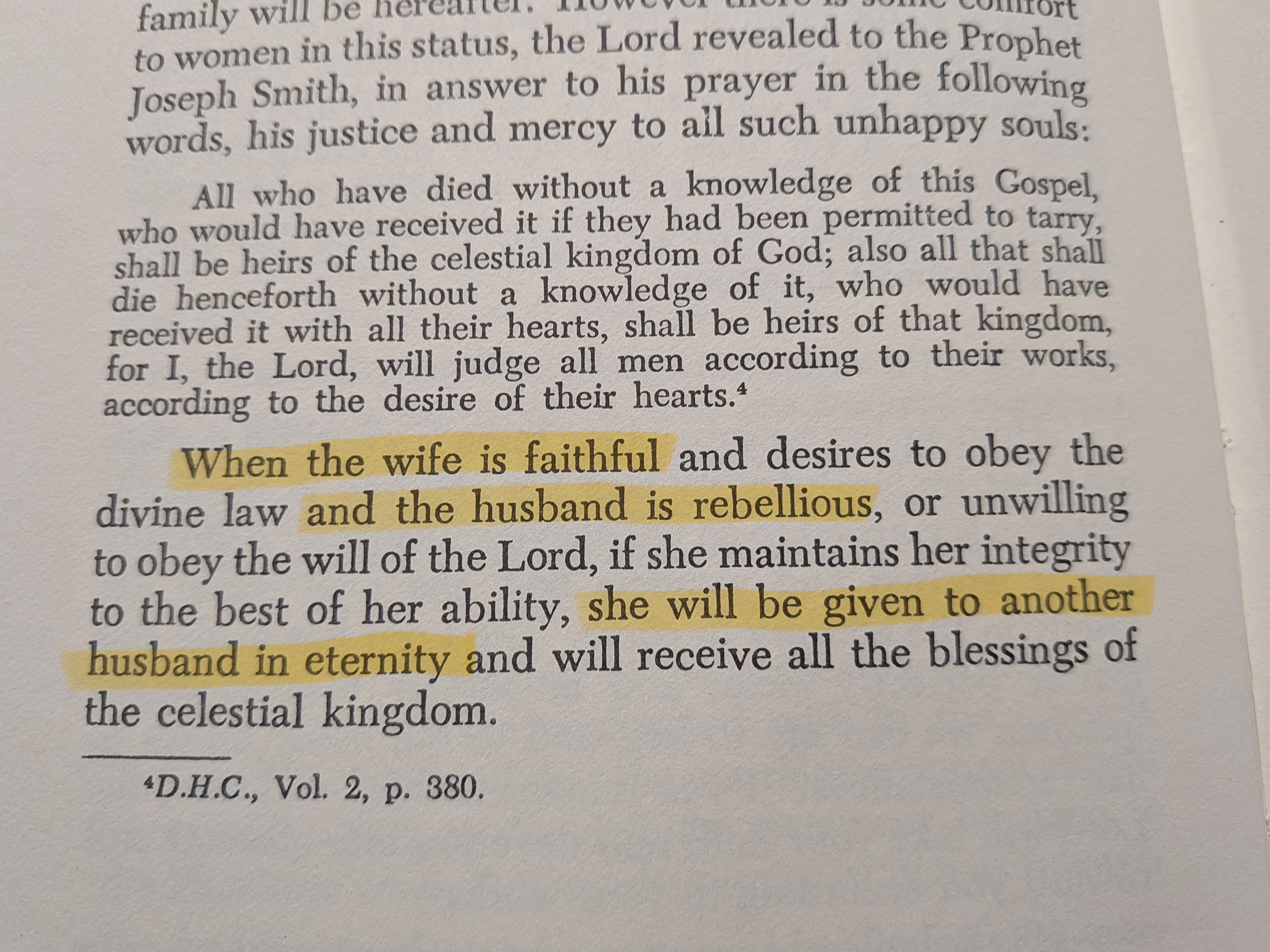
Most "hard" questions do have answers, but because they're controversial, they have been forgotten or ignored. Is this actually doctrine, or simply his opinion? Prophets don't teach opinion, so it must be doctrine.
The Church as Christ's Representative
Kevin S. Hamilton taught: "Could I suggest an alternative approach? Substitute the word Savior or Lord or Jesus Christ in place of 'the Church' - as in 'I don't support the Savior's policy on (again, you fill in the blank)' or 'I don't agree with the way Jesus Christ does (this or that)'" (Why a Church? | Kevin S. Hamilton | BYU).
Kevin teaches that we should say "I disagree with Christ's policy." But he fails to take the examples to completion - I'll do so:
- "I disagree with Christ's policy that bans children from being baptized if their parents are gay."
- "I disagree with Christ when he commanded Joseph Smith to marry women already married."
- New Headline: "Jesus Christ Wins Lawsuit!"
- Jesus changed the Book of Mormon introduction page because he isn't quite sure who the ancestors of the Native Americans are.
- Jesus Christ finally disavows the theory, that his Apostles propagated for 100 years, that dark skin is a curse.
- Jesus fined $5 million for obscuring his wealth for 20 years - Jesus claims the legal counsel he was given was wrong.
- Jesus builds a new mall
- Jesus just sold an unused chapel for $2 million
- Christ implements policy, payment of tithing is now required in order to visit the temple - Jesus explains it isn't about the money, but about loyalty.
- Jesus says that even the destitute must pay tithing; he will take you grocery shopping.
- Jesus donates food and clothing to those in need this Holiday season.
- Jesus refuses to disclose his financial report, says he doesn't want people telling him how to spend his money.
These examples don't help the Church's image. In fact, they show how much the church is not guided by Christ.
This teaching suggests that the Church represents Christ in all matters - that disagreeing with Church policy means disagreeing with Christ Himself. This is theologically problematic. It leaves no room for institutional error or human fallibility in Church leadership. If the Church and Christ are effectively the same, then every policy, decision, legal action, and teaching represents Christ's direct will. This claim can't be sustained given the documented pattern of policy reversals, doctrinal changes, and ethical failures within the institution.
Selective Obedience to Prophetic Counsel
Can members choose to follow some prophetic teachings while rejecting other teachings? Are prophetic instructions merely suggestions, or are they binding? Do instructions have an expiration date - who decides when something no longer applies? How does picking and choosing affect worthiness? Examples include:
- Multiple ear piercings (Your Greatest Challenge, Mother - Gordon B. Hinckley - General Conference October 2000)
- Watching R-rated movies (To the Youth of the Noble Birthright - Ezra Taft Benson - General Conference April 1986)
I have heard some people say: “Well that was only applicable at that time”, or “that was a different time”, or “That doesn’t apply any more”.
- How long is prophetic counsel applicable?
- How long should one wait until they decide the prophetic counsel no longer applies to them?
Can I decide that other instructions no longer apply to me?
- Can I decide that tithing doesn't apply to me?
- Can I decide that the Word or Wisdom or the Law of Chastity doesn't apply to me?
- Response: No - because these are "more important" than the other examples I gave. That mentality is wrong - even Christ recognized that when asked "Which is the greatest commandment?" Why can I ignore some and not others? Who chooses what is applicable and what is not? It is an infuriating pattern of hypocritical judgment and double standards.
The Church teaches that members have agency and can choose whether to follow prophetic counsel. Yet temple recommend interviews include questions about sustaining Church leaders and following their guidance. Members who openly disagree with prophetic teachings risk being denied temple recommends. This creates a requirement to go along with all prophetic counsel, even when you disagree.
The Afterlife and "Getting Your Own Planet"
For generations, Church members were taught in Primary, youth classes, and seminary that faithful members would "create worlds" or "get their own planet" in the afterlife, having "spirit children and making new worlds for them to live on" (Gospel Fundamentals | Book | Chapter 36, Page 201).
The Church's recent FAQ addresses this teaching: "Do Latter-Day Saints believe that they will 'get their own planet?' No. This idea is not taught in Latter-Day Saint scripture, nor is it a doctrine of the Church. This misunderstanding stems from speculative comments unreflective of scriptural doctrine. Latter-Day Saints believe that we are all sons and daughters of God and that all of us have the potential to grow during and after this life to become like our Heavenly Father (see Romans 8:16-17). The Church does not and has never purported to fully understand the specifics of Christ's statement that 'in my Father's house are many mansions' (John 14:2)" (FAQ | LDS Newsroom).
Wrong! Quotes that confirm "we do get a planet!!!"
- "Brethren, 225,000 of you are here tonight. I suppose 225,000 of you may become gods. There seems to be plenty of space out there in the universe. And the Lord has proved that he knows how to do it. I think he could make, or probably have us help make, worlds for all of us, for every one of us 225,000." President Spencer W. Kimball (https://www.churchofjesuschrist.org/study/general-conference/1975/10/the-privilege-of-holding-the-priesthood?lang=eng)
- "My Father worked out His kingdom with fear and trembling, and I must do the same; and when I get my kingdom, I shall present it to My Father, so that He may obtain kingdom upon kingdom, and it will exalt Him in glory." Joseph Smith (https://www.churchofjesuschrist.org/study/ensign/1971/04/the-king-follett-sermon?lang=eng)
- "Being joint-heirs of all that the Father has, we may then look forward to using those powers to organize still other worlds from the unorganized matter that exists throughout boundless space. Creating other worlds, peopling them with our own eternal posterity" New Era Church Magazine (https://www.churchofjesuschrist.org/study/new-era/1971/04/people-on-other-worlds?lang=eng)
- "We learn both the spiritual things and the secular things 'so we may one day create worlds [and] people and govern them' President Spencer W. Kimball (https://www.churchofjesuschrist.org/study/ensign/2002/10/education-for-real-life?lang=eng)
- "Then they gained the power and godhood of their Father and were made heirs of all that he had, continuing his works and creating worlds of their own for their own posterity—the same as their Father had done before, and his Father, and his Father, and on and on." New Era Church Magazine (https://www.churchofjesuschrist.org/study/new-era/1971/04/people-on-other-worlds?lang=eng)
- "He knew that the only way His children could become righteous enough to live with Him again through all eternity, and create worlds of their own, was if they were able to make their own choices." The Friend Church Magazine (https://www.churchofjesuschrist.org/study/friend/1994/03/abraham?lang=eng)
Of course, defenders of the Church will explain that these sources were just opinions of those giving the teachings.
Why would the Church publish that FAQ? Because the public and members had questions! "The Mormons believe if they are righteous then they get a planet after they die - weirdos!", "Do we really get our own planet? That sounds weird." These revisions make it seem like the Church is attempting to be less weird and more mainstream. For decades, this idea was not presented as speculation but as established doctrine taught in official Church settings and materials. Members were not told that the Church lacked understanding of the afterlife; they were given hopeful descriptions of the afterlife; of creating worlds and having spirit children. The current FAQ dismisses those teachings as speculative comments and says the Church has never claimed to fully understand the details. That directly conflicts with how earlier generations were taught. This is so wrong! The Church knows what was taught and said by prophets - who speak for God.
Chapter 15: Conclusions
In exploring these topics, I've encountered these non-answer responses that don't actually address the underlying questions:
- "Continuing Revelation"
- "That was a policy, not doctrine"
- "He was talking as a man"
- "He was lying for the Lord"
- "It was a different time"
- "Have faith, all will be revealed one day"
- "We aren't meant to know that at this time"
- "It will all be resolved after this life"
- "The Church disavows that teaching"
- "Pray more"
- "Pray, read your scriptures, pay your tithing, go to Church."
- "You're asking these questions with the wrong intent"
- "You're only questioning your faith because there is something in your life influencing you to make wrong choices."
My current conclusions are:
- The Church is not the source of truth it claims to be. For 200 years, the Church has taught that ONLY through obedience to the teachings of the Church is happiness and exhalation possible - yet, the Church changes the requirements, disavows teachings, revises history, etc. The “requirements” for eternity are not variable.
- All religions and churches are creations of men. They require your time and money, and those who don't participate are considered unworthy.
- The Church has changed doctrine and policies over time, often in response to leaders' opinions, cultural, political, or social trends.
- The Church has disavowed and condemned past ideas, doctrines, and stories now recognized as wrong. If these things are wrong now, they were wrong then - morality and integrity are not fluid. The Church's inconsistent doctrine and policies are not a "firm foundation" (How Firm a Foundation | Hymns | Page 85).
I was completely in on all Church teachings. The inconsistency and institutional immorality have demonstrated to me that the Church is simply a creation of Men who have their own agenda. Sometimes the Church does good, and sometimes it does harm. This is not Christlike. It is just another corporation - and Christ is not the CEO.
I expected more from the Church. I expected better. Each of these issues has contributed to breaking my faith, little by little. It was painful. But I’m better now - I've replaced my broken faith with a stronger desire to live a good life.
So what now? With all this research and discovery, how do I move forward with my faith? Answer: not with the Church nor any other church - similar issues are found in all Christian denominations, and across all religions. So what do I do? Here is what I believe:
- I believe in God. Human arrogance would have us believe we can understand the will of God. I reject that notion. I believe that God simply wants us to live a good and fulfilling life.
- I believe that Christ taught plainly, and that religions have misunderstood, twisted, and complicated his teachings. I believe that his simple teachings and example are all we need. I want to follow his example.
- I believe that my faith is personal and internal, it is not dictated by worthiness or defined by a Church.
I choose to follow the simple teachings of Christ, which are to love God and love others, and have empathy. No bureaucracy, handbooks, callings, or minutia. I will try to do better each day, and will fail. That is the best I can do, and it is enough. I feel at peace and I am happy.
Appendix - The Simple Teachings of Christ
Christ's teaching was simple. When asked which commandment mattered most, he did not respond with a system, an institution, a priesthood hierarchy, a temple program, or a list of ordinances. He said: "Thou shalt love the Lord thy God with all thy heart, and with all thy soul, and with all thy mind... Thou shalt love thy neighbour as thyself. On these two commandments hang all the law and the prophets" (Matthew 22:37-40). That is the Gospel. No more and no less. Christ taught it plainly, and he lived it plainly. Simply love. Love God, love others.
He taught the same pattern everywhere he went. He told his followers, "A new commandment I give unto you, That ye love one another; as I have loved you" (John 13:34-35). He taught service: "whosoever will be chief among you, let him be your servant" (Matthew 20:25-28). He taught mercy through the parable of the good Samaritan, where the true neighbor was the one who showed compassion, not the one who held the correct religious position (Luke 10:25-37). He taught that what we do for the hungry, the stranger, the sick, and the imprisoned, we do unto him (Matthew 25:34-40). His message was practical, moral, and deeply human: love and serve.
Even the Sermon on the Mount was not a codified checklist. Christ gave examples of what this life looks like - refusing hatred, practicing mercy, loving enemies, forgiving freely, doing good without display, and seeking God over status - not to create a new rulebook, but to teach a pattern and a way of being (Matthew 5-7). The point was the kind of person to become, not merely a list of do’s and do-not’s.
Christ repeatedly pushed faith away from outward religious performance and toward inward transformation - a pattern of inward transformation. He warned against "laying aside the commandment of God" in order to hold to the "tradition of men" (Mark 7:8-9). He taught that defilement does not come from external things but from what comes out of the heart (Mark 7:14-23). He rebuked religious leaders who cleaned the outside while leaving the inside unclean (Matthew 23:25-28). He said, "the kingdom of God is within you" (Luke 17:20-21), and taught that true worship would be "in spirit and in truth" rather than bound to sacred locations or inherited religious systems (John 4:21-24).
I reject the argument that something essential was "missing" from Christ's message and that the missing pieces require a restoration. What people often call "missing" is usually the opposite: later additions, later structure, later administration, later control. Christ's teaching was already complete in its simplicity. It did not need to be supplemented with bureaucracy. It did not need layers of authority inserted between the soul and God. It did not need a return to external religious management.
Even within the New Testament, you can see how quickly the movement became more institutional. Offices had to be filled, roles had to be assigned, disputes had to be managed, and qualifications had to be defined (Acts 1:23-26; Acts 6:1-6; 1 Timothy 3:1-13). In my view, that is not proof that Christ intended a permanent hierarchy. It is evidence that ordinary men, shaped by their culture and by the Hebrew religious world they came from, naturally rebuilt structure around a message that had challenged structure. They did what people always do: they organized, regulated, and administered what Christ had made personal, inward, and spiritual.
That drift matters because it changes how people understand nearly everything. Baptism, for example, was too easily fixed on the external act, even though John himself contrasted water with the greater baptism of "the Holy Ghost, and with fire" (Matthew 3:11). Christ's emphasis was consistently on inner rebirth and inner cleansing, not on ritual performance alone (John 3:5-8). The same applies to rituals generally. Christ fulfilled the old pattern rather than re-entrenching it. At his death, "the veil of the temple was rent in twain" (Matthew 27:51), which symbolizes to me that barriers, gatekeepers, and sacred exclusions were supposed to end, not be recreated in a new form.
The same principle applies to religious organization. Christ said, "all ye are brethren" and warned against religious status and elevation (Matthew 23:8-12). He did not teach that spirituality would be authenticated by offices, titles, interviews, or institutional worthiness. He taught that the measure is love, mercy, forgiveness, humility, and service. Once religion is turned into management, programs, ranks, and compliance, it begins to resemble the very world Christ criticized.
For me, that is the central error in restorationist thinking. It assumes Christ's teaching was insufficient. I believe the opposite. It was sufficient precisely because it was simple. The problem was not that Christ left out essential structure. The problem is that later believers, including the Apostles, could not leave simplicity alone. They complicated what was meant to be lived. They externalized what was meant to be inward. They institutionalized what was meant to be personal.
So when I think about baptism, rituals, doctrine, or church organization, I return to Christ's plain pattern. Love God. Love others. Serve the needy. Forgive. Be honest. Be humble. Refuse religious vanity. Seek inward goodness over outward display. That is enough. That was enough when Christ taught it, and it is enough now. The purest form of faith is not managed through a religious machine. It is lived quietly in the soul and expressed in how we treat other people.